
Looking for the best lucky food for New Year 2027? Food plays an important role in Lunar New Year celebrations, with many traditional dishes chosen because their names, shapes, colors, or preparation methods are associated with prosperity, family unity, happiness, longevity, and abundance.
In 2027, Lunar New Year begins on February 6, welcoming the Year of the Fire Goat.
From whole fish and dumplings to longevity noodles, rice cakes, oranges, and tangerines, families may serve symbolic foods as part of their Chinese New Year traditions.


These foods are symbolic and can attract blessings for you in the New Year.
If you’re preparing your own lucky New Year celebration, this guide explains 17 traditional and symbolic foods, the Feng Shui Lucky Food For New Year 2027, what they represent, and simple ways to serve them.
These traditions are best understood as Chinese cultural and folk customs rather than guarantees that eating a particular food will literally create wealth, health, or good fortune.


Quick Answer: What Are the Luckiest Foods for New Year 2027?
Some of the best-known lucky foods for Lunar New Year include whole fish, dumplings, spring rolls, longevity noodles, glutinous rice cake (nian gao), sweet rice balls (tangyuan), whole chicken, oranges, tangerines, and pomelo.
| Lucky New Year Food | Traditional Symbolism |
|---|---|
| Whole fish | Surplus and abundance |
| Dumplings | Wealth and prosperity |
| Spring rolls | Wealth |
| Nian gao | Growth and advancement |
| Longevity noodles | Long life |
| Tangyuan | Family togetherness |
| Whole chicken | Unity and wholeness |
| Mandarin oranges | Good fortune |
| Pomelo | Prosperity and blessings |
These are among the most recognizable lucky dishes for Chinese New Year, although exact foods and customs can vary considerably between regions and families.
Why Are Certain Foods Considered Lucky for Lunar New Year?

The meaning behind many lucky Chinese New Year foods comes from wordplay, appearance, preparation methods, or long-established family customs.
For example, fish is associated with surplus because the Chinese word for fish sounds like a word associated with surplus. Long noodles represent wishes for longevity, while dumplings can resemble historical Chinese ingots and therefore became associated with prosperity.
Round foods can also represent completeness and reunion, while colors such as red and gold have strong auspicious associations.
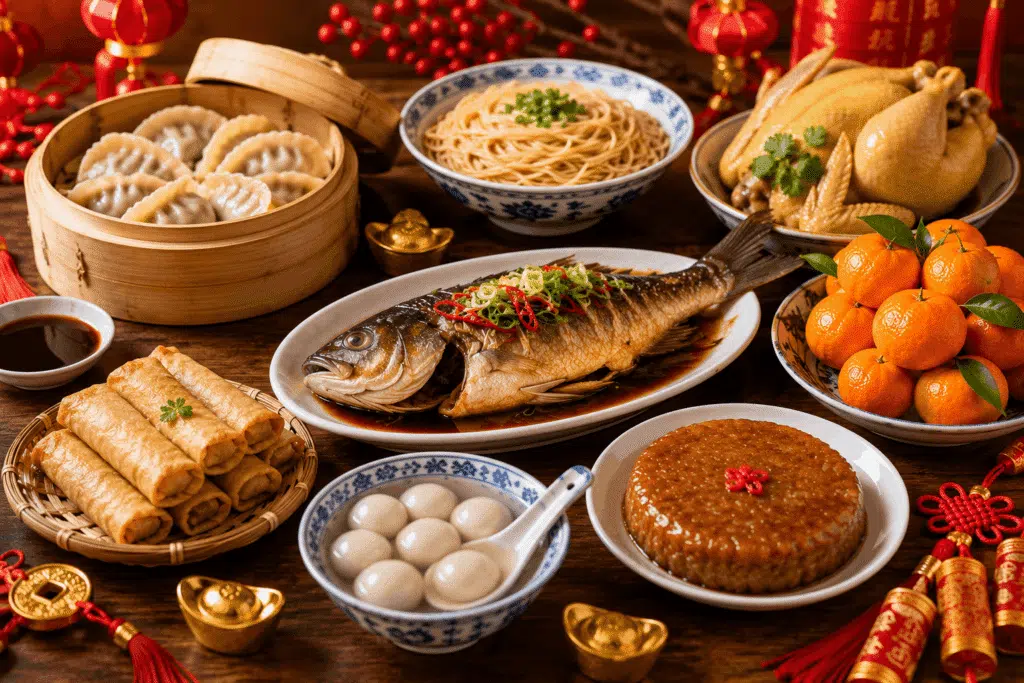
The Smithsonian’s National Museum of Asian Art describes a traditional New Year table containing mandarin oranges, dumplings shaped like silver ingots, whole fish, and sweet glutinous rice cake. It also explains how wordplay contributes to the symbolic meanings of these foods.
This is an important distinction when discussing Feng Shui food: the food itself isn’t a magical cure. Rather, these dishes form part of broader cultural traditions expressing wishes for prosperity, happiness, progress, longevity, and family unity.
You can complement your New Year table with traditional lucky flower decorations and other symbolic items associated with happiness and abundance.
17 Feng Shui Lucky Foods For New Year Celebration
There are some foods used during the Chinese New Year to bring good luck and fortune. Check out the 17 foods that can give you good luck in the Chinese New Year.


1. Chinese Dumplings — For Wealth
The Chinese Dumplings symbolize wealth, and eating them on the New Year can bring abundance, prosperity, and good luck.
Chinese dumplings are prepared by adding certain ingredients, such as minced meat, together with lightly chopped vegetables draped in a slightly stretchy dough skin.
The most common fillings for Chinese dumplings include shredded shrimp, vegetables, beef, chicken, fish, and chopped pork.
2. Fish: For Boosting Prosperity
Fish is one of the most popular foods used to mark the Chinese New Year occasion.
As a traditional dish, the fish recipe is nutritious and enriching, and serving this recipe boosts prosperity and facilitates abundance in the New Year.
Fish is an auspicious food that attracts good luck. The symbolism of fish centers on having sufficient fish and keeps over to the New Year. This is interpreted as having enough things in the New Year.
3. Spring Rolls — For Abundance
This dish is traditionally prepared for the Chinese New Year because of its symbolism of wealth. Spring rolls are common in East China such as Guangzhou, Shanghai, Jiangsu, Fujian, etc.
Preparing spring rolls required wrapping the fillings in thin dough wrappers, proceeding with frying, and serving when you get a golden-yellow color.
4. Glutinous Rice Cake: Elevation at Work, Increased In Income
Glutinous rice cake is pronounced “going higher every year” in Chinese. Its symbolism while eating is gaining a higher position and prosperity in business and life.
If you want to enjoy advancement in your endeavors, let this meal be part of the dish you will serve in the New Year.
Also read- Lucky color of the year 2026
5. Sweet Rice Balls — For Family Reunion
The sweet rice ball is a favorite dish among the Chinese and is used to celebrate the New Year because of its symbolism to strengthen the family bond and reunion.
6. Longevity Noodles — For Happiness and Long Life
Just as the name suggests, longevity noodles signify the desire for long life. The symbolism of this dish is from its length and non-detached cooking.
Eating this recipe on Chinese New Year’s Day can make you enjoy longevity.
7. Oranges and Mandarin: For Richness and Wealth
Some fruits such as mandarin, tangerines, oranges, and pomelo are used to celebrate the Chinese New Year time, and they are preferred because of their round shape and golden skin.
Which symbolizes richness, abundance, and wealth. They are known as good-luck fruits.
8. Grapes: For Wealth and Prosperity
Grapes are used for celebrating the New Year because they symbolize good luck, wealth, and prosperity. Grapes are recognized as a fortunate fruit that can bring prosperity.
9. Whole Simmered Chicken — For Unity and Relationship
The Chinese prepare a whole for the New Year celebration, which is eaten by the family. Through this, their family is reunited.
Therefore, the chicken dish symbolizes joy, well-being, and integrity, and serving it completely means wholeness and family unity. While serving, don’t remove the head and claws.
10. Vegetable Recipes for Wealth and Fortune
Common vegetable recipes prepared for the New Year are:
- Seaweed: represents prosperity and fortune
- Lotus seeds: symbolize a vibrant family.
- Bamboo shoots: symbolize longevity, elevation, and promotion.
- Muskmelon: represents harmony and aspiration
- Leek: symbolizes longevity.
11. Pork: For Abundance, Strength, and Peace
Pork is a favorite meat dish for the New Year‘s celebration as it brings good luck related to fertility, abundance, and prosperity.
12. Pecking Duck: Unity, and Loyalty
Duck is a common dish found at dinner to celebrate Chinese New Year. Pecking duck is a symbol of loyalty and it gives luck which makes it auspicious. Also, a duck has red skin which is an auspicious color.
13. Red Protein: Joy, Strength, Elegance, and Beauty
Red Food is included in the meal served during the Chinese New Year celebration. Red foods are good luck food because of the red color present.
The red color is symbolic of Feng Shui and is a lucky color. Common proteins used for the celebration are char siu and roasted barbecue pork.
14. Year Cake (Nian-Gao) — Wellbeing, Prosperity, and Happiness
Year Cake is a preferred Chinese dessert that is eaten when the Chinese New Year festival is celebrated. It is enunciated as Nian Gao, which is similar to the word “higher year.”
The Year Cake is a lucky meal produced from sticky rice flour and commonly consumed on New Year’s Day. The symbolism of the Year Cake is prosperity, happiness, and well-being.
15. Lobster and Shrimp: Fortune and Luck
Many red foods are prepared at the Chinese New Year celebrations apart from duck. Crustaceans such as lobsters and shrimp are red foods too that are auspicious and bring good luck when served.
16. Big Meat: Power, Strength, Prosperity, and Peace
The Chinese New Year is celebrated lavishly, and it is a period that witnesses the generous cutting of complete animals served with different meat and with a diverse range of decorations.
17. Leftovers — Excess, and Surplus
This superstition makes the Chinese intentionally allow leftovers of their foods and this symbolism of abundance and excess in the New Year.
So, if you are looking for New Year’s food that will bring good luck, cook more than your family can eat, and let there be leftovers.
Find below more food items and how they are served traditionally.
| Food | How to Eat |
|---|---|
| Fish | Served whole |
| Dumplings | Often shaped like ancient Chinese ingots |
| Noodles | Long noodles are served |
| Spring rolls | Shaped like gold bars |
| Tangerines and oranges | Can be given as gifts |
| Chicken | Often served whole |
| Pork | Used in traditional dishes |
| Lotus seeds | Served with dumplings |
| Nian Gao | Sticky rice cakes |
| Longan fruit | Fruit salad |
| Red bean paste | Prepared with buns |
| Chinese dates | Used in sweet dishes |
| Chestnuts | Salad and sweet bread |
| Peanuts | Boiled dishes and stuffing |
| Grapes | Often eaten as a snack |
| Melon seeds | Paired with salad dishes |
| Turnips | Can be part of traditional dishes |
| Lettuce | Eaten as raw salads |
| Carrots | Momo recipes as a stuffing |
| Eggplant | Paired with many dishes that are traditional |
How Should Lucky New Year Foods Be Served?
| Food | Traditional Serving Idea |
| Fish | Often served whole |
| Dumplings | Shaped somewhat like traditional ingots |
| Longevity noodles | Served long rather than intentionally cut |
| Spring rolls | Fried until golden |
| Mandarins & oranges | Displayed or exchanged |
| Chicken | May be served whole |
| Nian gao | Served in sweet or savory preparations |
| Tangyuan | Served as round rice balls in soup |
| Pomelo | Displayed or served fresh |
| Vegetables | Combined into festive dishes |
What Are the 7 Luckiest Foods for Chinese New Year?
If you don’t want to prepare 17 different foods, start with five of the most recognizable:
- Whole fish — surplus and abundance
- Chinese dumplings — wealth
- Spring rolls — prosperity
- Nian gao — advancement
- Longevity noodles — long life
- Glutinous Rice Cake
- Sweet Rice Balls
The exact menu isn’t universal.
The Library of Congress notes that Lunar New Year food customs vary according to family and regional traditions. Some families eat dumplings, some share whole fish, while others follow meat-free customs.
You can also explore our Money Bowl for Prosperity guide for another traditional Feng Shui-inspired New Year activity.
8 Lucky Fruits for New Year 2027
Fruit makes one of the simplest additions to a Feng Shui New Year table.
Here are eight fruits commonly associated with auspicious symbolism across Chinese and broader New Year traditions:
| Lucky Fruit | Traditional Association |
| Mandarin oranges | Good fortune and prosperity |
| Tangerines | Luck and prosperity |
| Pomelo | Abundance and blessings |
| Pineapple | Prosperity in some Chinese communities |
| Pomegranate | Abundance and many descendants |
| Apple | Peace |
| Peach | Longevity |
| Grapes | Abundance in broader New Year traditions |
What Are 5 Lucky Fruits for Chinese New Year?
If you only want five fruits for your table, consider:
- Mandarin oranges
- Tangerines
- Pomelo
- Pineapple
- Pomegranate
Among these, mandarins, tangerines, and pomelo have particularly recognizable connections with Chinese New Year celebrations.
Other fruit traditions can vary considerably by country, community, and household.
Oranges and Tangerines
Oranges and tangerines are easy choices because they can serve as both food and decoration.
Place them in a clean bowl on your dining table or kitchen counter, or offer them to guests.
Chinese New Year traditions also include giving mandarin oranges as gifts.
Pomelo
Pomelo’s large round shape and citrus family connection make it another popular festive fruit.
It can be served fresh or displayed with mandarins.
Pineapple
Pineapple is considered auspicious in some Chinese communities because of linguistic associations with prosperity.
Its golden color also makes it visually appropriate for a New Year table.
Pomegranate
The many seeds inside a pomegranate have traditionally made it a symbol of abundance, fertility, and numerous descendants.
Grapes
Grapes are better described as part of broader New Year lucky-fruit traditions rather than one of the most important traditional Chinese Lunar New Year fruits.
This distinction helps avoid mixing unrelated New Year customs.
How Many Fruits Should You Put Out for New Year 2027?
There is no universal Chinese New Year rule requiring one exact number of fruits.
You may see recommendations online for 5, 8, 9, 12, or other numbers, but these can come from different regional, family, Feng Shui, or modern New Year traditions.
For a simple table, choose 3–5 types of meaningful fruit rather than worrying about reaching an exact number.
For example:
Mandarins + Tangerines + Pomelo + Pineapple + Pomegranate
This creates a colorful fruit display without unnecessary waste.
How to Create a Lucky Lunar New Year Table at Home
You don’t need to prepare every food in this guide.
For a manageable celebration at home, try this simple menu:
- Starter: Dumplings or spring rolls
- Main dish: Whole fish or whole chicken
- Vegetarian main: Buddha’s Delight or vegetable dumplings
- Noodles: Longevity noodles
- Dessert: Nian gao or tangyuan
- Fruit: Mandarin oranges, tangerines, and pomelo
The goal is not to pack the table with as many “lucky” items as possible.
Choose dishes your family will actually enjoy and use their symbolism as a meaningful part of the celebration.
Lucky Food for House Blessing: Can You Use These Foods?
Some readers also look for lucky food for house blessing Feng Shui traditions.
There is no universal Feng Shui rule stating that you must serve a particular dish when blessing a new home.
However, if you’re combining a housewarming or blessing with a New Year celebration, symbolic foods can be a meaningful addition.
For example:
- Oranges or mandarins — wishes for prosperity
- Dumplings — wealth symbolism
- Tangyuan — family togetherness
- Nian gao — progress
- Whole fish — surplus and abundance
Think of these foods as part of the celebration rather than mandatory Feng Shui cures.
For the actual home ritual, see our complete Feng Shui House Blessing guide.
Feng Shui Food: Does Food Really Bring Good Luck?
This is where Feng Shui food and traditional New Year symbolism need to be separated from literal promises.
Eating a dumpling doesn’t guarantee wealth.
Eating noodles doesn’t medically guarantee longevity.
Serving fish doesn’t guarantee a profitable year.
Instead, symbolic foods help families express their intentions and hopes for the coming year.
You might serve:
- Fish while wishing for abundance.
- Noodles while wishing someone a long, healthy life.
- Tangyuan while celebrating family togetherness.
- Nian gao while hoping for progress.
- Mandarins while wishing guests prosperity and good fortune.
That cultural symbolism is what makes these foods meaningful.
Lucky Foods for Lunar New Year: Tradition Can Differ by Family
There isn’t one single menu followed by every Chinese family.
The Library of Congress notes that Lunar New Year foods vary according to family and regional traditions. Dumplings may be important in one household, whole fish in another, while some families observe vegetarian traditions.
That means you don’t need to worry if your own New Year dinner looks different.
The symbolism should complement the celebration—not make preparing dinner stressful.
What are 8 Chinese New Year food symbols?
Eight easy examples are:
- Fish — surplus
- Dumplings — wealth
- Spring rolls — prosperity
- Nian gao — progress
- Longevity noodles — long life
- Tangyuan — family unity
- Whole chicken — wholeness
- Mandarin oranges — good fortune
17 Feng Shui Lucky Food For New Year FAQs
Food To Celebrate Lunar New Year
Some foods are perfect to mark the Lunar New Year. The Chinese are accustomed to these foods because of tradition.
The food you can use to celebrate Lunar New Year is long-life noodles for longevity, full steamed fish for wealth and prosperity, and sticky rice balls to strengthen family unity.
And citrus fruits such as grapes and mandarin for good fortune and abundance, etc.
How many oranges can you present as a Gift to people during the Chinese New Year?
It is a tradition to give oranges during the Chinese New Year. Oranges are the fruit that brings good luck signifying fortune, and abundance.
Based on the Chinese tradition of celebrating New Year, you give two mandarin oranges using both hands.
Is Egg Lucky In New Year?
An egg is not something that is mostly eaten during the New Year celebration.
This is because eggs are whitish which is the color worn for mourning a dead person.
So, because an egg’s color centers around death, it is counted inauspicious to eat it on New Year’s Day.
Is Pineapple Lucky For New Year?
Yes! Pineapple is a lucky fruit that can be eaten for the New Year. According to Chinese tradition, pineapple fruit represents wealth and good luck.
Lucky Feng Shui Fruits For New Year
Here are some of the Feng Shui fruits to mark the Chinese New Year:
Citrus fruits such as Mandarin, Tangerines, Oranges, Pomelo, Grapes, etc.
These fruits can help you to experience fortune, prosperity, fruitfulness, abundance, and happiness in the New Year.
Is Squid Lucky Food For New Year?
Yes! Squid is a lucky food that can be eaten for New Year. It falls in the class of kinds of seafood that bring good luck.
Feng shui color of the year 2026?
In the year 2026, the feng shui color of the year is expected to be green.
This color is said to be a symbol of new beginnings and fresh energy. In addition, it is thought to promote productivity and increase wealth.
8 Chinese New Year food symbols?
There are many different Chinese New Year food symbols. Here are 8 of them:
8 Chinese New Year food symbols:
1. Golden eggs
2. Crane egg
3. Pork liver pate
4. Sesame seed balls
5. Red onion and green onion soup
6. Squid ink soup
7. Rice paper rolls with egg
8. Pork filling
What food should I eat for Lunar New Year?
Some of the most recognizable foods include whole fish, dumplings, longevity noodles, nian gao, tangyuan, spring rolls, whole chicken, mandarins, and pomelo.
Is squid a lucky food for Chinese New Year?
Seafood appears in many celebration meals, but squid isn’t as universally recognized as a Chinese New Year luck symbol as whole fish.
If you’re choosing foods specifically for their well-established symbolic meanings, prioritize fish, dumplings, noodles, nian gao, tangyuan, and citrus fruits.
What are the best lucky fruits for Chinese New Year 2027?
Mandarin oranges, tangerines, and pomelo are excellent starting choices.
Pineapple and pomegranate can also be incorporated depending on your family’s cultural traditions.
Is pineapple lucky for New Year?
Pineapple carries auspicious associations in some Chinese communities and is often linked with prosperity.
It can be included alongside more widely recognized Lunar New Year citrus fruits such as mandarins, tangerines, and pomelo.
How many oranges should you give during Chinese New Year?
Giving mandarins or oranges is a popular New Year custom, but exact practices can vary between families and communities.
Rather than treating one number as a universal Feng Shui requirement, follow the tradition practiced by your family or community.
Why is nian gao considered lucky?
Its name is connected through wordplay with the idea of becoming higher or advancing year after year.
For this reason, it can symbolize progress in study, work, business, or personal life.
Why are longevity noodles eaten at Chinese New Year?
Their length represents wishes for longevity and long life. Traditionally, the noodles aren’t intentionally cut short.
Why are dumplings lucky for Chinese New Year?
Jiaozi dumplings can resemble historical Chinese ingots, contributing to their association with wealth and prosperity.
Why is fish lucky during Chinese New Year?
The Chinese word for fish sounds like a word associated with surplus, which contributes to fish’s traditional New Year symbolism.
What are lucky foods for Lunar New Year?
The answer varies across cultures and families because Lunar New Year is celebrated in multiple countries and communities.
For Chinese New Year specifically, fish, dumplings, noodles, nian gao, tangyuan, citrus fruits, and chicken are among the best-known symbolic foods.
What are lucky dishes for Chinese New Year?
Popular symbolic dishes include whole fish, jiaozi dumplings, spring rolls, nian gao, longevity noodles, tangyuan, whole chicken, and festive vegetable dishes.
What is the luckiest food for Chinese New Year?
Each food carries different traditional symbolism. There isn’t one universally “luckiest” food.
Whole fish is particularly significant because it traditionally represents surplus and abundance, while dumplings are associated with wealth and noodles with longevity.
Welcome 2027 With Meaningful New Year Foods
The best lucky food for New Year 2027 isn’t necessarily one particular dish.
New Year food traditions are about bringing meaningful dishes to the table that represent what families hope to carry into the coming year—abundance, happiness, longevity, progress, peace, and togetherness.
Whole fish, dumplings, spring rolls, longevity noodles, nian gao, tangyuan, and citrus fruits are among the most recognizable lucky dishes for Chinese New Year.
Whether you’re preparing a large Lunar New Year dinner or simply placing a bowl of mandarins on your table, focus on enjoying the cultural symbolism and sharing food with people you care about.
You can also explore other New Year traditions through our Chinese New Year rituals guide, lucky flowers and fruits guide, 2027 lucky colors, and Feng Shui house blessing guide.
Happy Lunar New Year 2027!
Disclaimer: This article discusses traditional Chinese New Year, Lunar New Year, and Feng Shui beliefs for cultural, educational, and general informational purposes. Symbolic foods and Feng Shui practices do not guarantee wealth, health, longevity, or other outcomes.

Feng Shui is a well-researched combination of art and science based on neuroscience principles. Bhawana Rathore is a passionate Feng Shui practitioner. She writes at FengShuitricks.com and helps people to enhance and balance their lives by sharing Feng Shui-related information on FengshuiTricks and YouTube Channel. Check out more. If you find the information useful, you can buy me a coffee here.