

A dream catcher is more than a beautiful hanging decoration. Its woven web, circular hoop, beads, and feathers carry meanings associated with dreams, protection, and the connection between people and nature.
But what is the real dream catcher meaning, what are its benefits, and where should you place a dream catcher for a peaceful and welcoming home?
Dreamcatchers originated in Indigenous North American traditions, particularly among the Ojibwe (Anishinaabe) people. Today, they are also popular in bedrooms, meditation spaces, and modern home décor.

In this guide, we’ll explore 11 dream catcher benefits, their traditional purpose, dream catcher patterns and meanings, triangle and evil eye designs, colors, and practical placement ideas.
You’ll also learn how dreamcatchers relate to Feng Shui-inspired decorating—and why their original cultural meaning should be respected.


Quick Answer: What Is a Dream Catcher and What Does It Mean?
A dreamcatcher is a traditional woven object associated with protecting sleepers from disturbing dreams. In widely shared Ojibwe traditions, the web is understood as filtering dreams, while the hoop is often interpreted as representing the interconnected cycle of life.
Today, people also use dreamcatchers as symbols of protection, comfort, creativity, and peaceful surroundings.
The most important things to know:
- Meaning: Dream protection, connection, and well-being.
- Traditional purpose: Protection of sleeping children.
- Common placement: Bedroom wall or a secure location near a window.
- Popular designs: Circular, crescent moon, triangle, and evil eye.
- Feng Shui connection: A modern decorative adaptation, not a classical Feng Shui cure.
- Scientific evidence: No reliable evidence that a dreamcatcher prevents nightmares or changes energy.
For more ways to create a restful bedroom, explore our guide to sleeping well. You can also learn about creating a more comfortable bedroom through our Feng Shui home guide.
The contemporary plastic dream catchers available on the market are commercialized versions of the originals.
There are different theories about how a crescent moon dreamcatcher works, but they all have a similar meaning.
The dream catchers are used to bypass harmful thoughts or bad dreams like pregnancy and losing the baby dream and give one safety and security feeling. It also encourages a good night’s sleep well.
What Is the Meaning of a Dream Catcher?
The meaning of a dream catcher is closely connected to traditional beliefs about dreams and protection.
A typical dreamcatcher features a circular hoop containing a woven web, sometimes decorated with beads and feathers.
Its design resembles a spider’s web, an important element in some Ojibwe teachings.
The Traditional Dream Catcher Story
Dreamcatchers are strongly associated with the Ojibwe people and teachings involving Asibikaashi, often described as Spider Woman.
In a widely shared account, Spider Woman protected children and families. As communities spread farther apart, mothers and grandmothers created protective woven objects for children.
These objects became associated with filtering dreams and protecting sleepers.
Different communities and storytellers may explain the details differently, so there is no single interpretation that applies to every Indigenous tradition.
For authoritative background on Indigenous cultures, explore the Smithsonian National Museum of the American Indian.
Important cultural note: Dreamcatchers are not originally Chinese or classical Feng Shui objects. Their Indigenous origins should be acknowledged even when discussing modern decorative uses.
Click below to buy.

11 Dream Catcher Benefits and Uses
Many people search for dream catcher benefits because they want to understand what these beautiful objects are believed to do.
The following benefits include traditional beliefs, personal symbolism, and practical decorative uses. They should not be confused with scientifically proven effects.


1. Traditional Protection From Bad Dreams
The most widely recognized use of a dream catcher is its traditional association with protecting sleepers from disturbing dreams.
In one common interpretation, unwanted dreams become caught in the woven web.
This is a cultural and spiritual belief rather than a scientifically established sleep treatment.
2. Symbol of Peaceful Sleep
A dreamcatcher may make a bedroom feel comforting and personal.
Some people find that meaningful decorations help them create a relaxing bedtime environment.
However, dreamcatchers have not been shown to treat insomnia or recurring nightmares.
For a more comfortable sleeping environment, combine soothing décor with a consistent bedtime routine. Our guide to getting a good night’s sleep offers additional ideas.
3. A Reminder of Protection and Safety
Dreamcatchers are associated with protection in their traditional context.
For some people, a dreamcatcher represents care, reassurance, or a connection to family traditions.
This symbolic meaning is one reason dreamcatchers are sometimes given as gifts.
If you enjoy meaningful protective decorations, explore our Feng Shui protection guide and Feng Shui crystals and cures. These belong to different traditions, but they offer additional perspectives on symbolic home objects.
4. Beautiful Bedroom Decoration
Modern dreamcatchers come in many colors, sizes, and patterns.
A carefully selected piece can complement minimalist, bohemian, rustic, or nature-inspired interiors.
Choose one that suits your space without overwhelming the wall.
If you are decorating a child’s bedroom, our Feng Shui kids’ room guide offers ideas for arranging furniture, colors, and accessories.
5. Encourages a Calming Bedroom Atmosphere
Natural materials, soft colors, and gentle textures can contribute to a visually peaceful room.
A dreamcatcher may work well alongside neutral bedding, soft lighting, and uncluttered furniture.
For additional inspiration, read about Feng Shui bedroom eye-care and lighting tips and ways to create a relaxing home environment.
6. Represents Connection With Nature
Traditional dreamcatchers commonly incorporate natural materials such as willow, cord, and feathers.
These materials can remind people of the natural world and the importance of respecting it.
Natural textures can also complement interiors inspired by the five Feng Shui elements, although dreamcatchers themselves are not traditional Chinese Feng Shui cures.
7. Inspires Creativity
The intricate woven patterns make dreamcatchers interesting examples of textile craftsmanship.
Creating a decorative dreamcatcher can be an enjoyable craft activity, especially when its cultural background is taught respectfully.
8. Adds Personal Meaning to a Meditation Space
Some people display dreamcatchers near their meditation or reflection areas.
The object can serve as a visual reminder to slow down and focus.
This is a modern personal use, not a universal traditional practice.
If you enjoy mindful home arrangements, explore our Feng Shui practices for spiritual growth.
9. Makes a Meaningful Gift
A thoughtfully chosen dreamcatcher can symbolize care, protection, and good wishes.
Whenever possible, consider buying from an authentic Indigenous artist or maker.
You can also explore our Feng Shui gift ideas for other meaningful home presents.
10. Complements Nature-Inspired Home Décor
A dreamcatcher made with wood, natural fibers, and restrained colors can complement a home decorated with plants and natural textures.
These design choices can also work alongside Feng Shui’s five elements, although this is a contemporary decorative combination rather than a traditional dreamcatcher rule.
11. Encourages Reflection on Dreams
Some people keep a dream journal near their bed.
A dreamcatcher may act as a visual reminder to record dreams, emotions, and recurring themes.
If you are curious about dream interpretation, explore our article about dreams involving pregnancy.

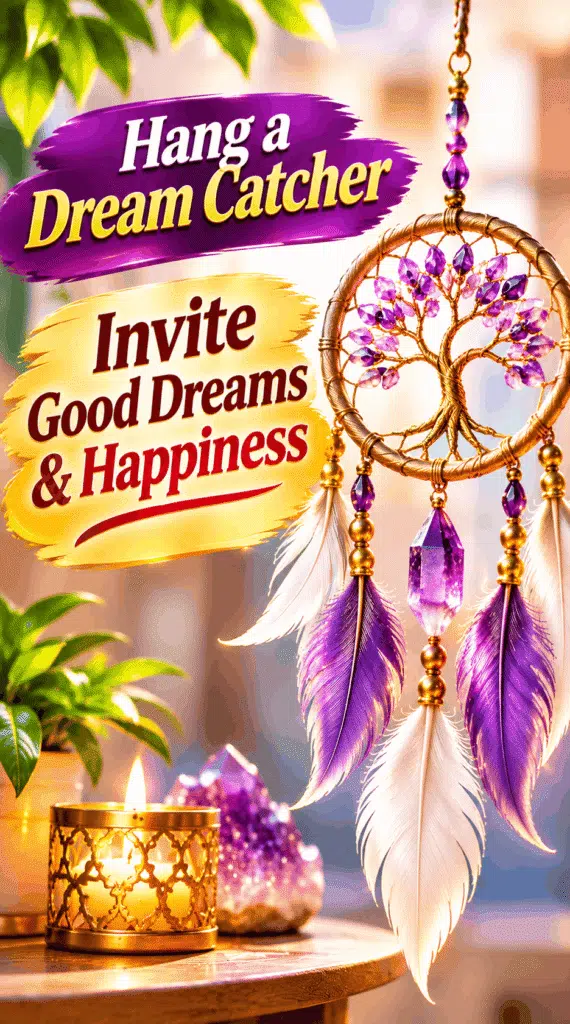
Dream Catcher Benefits at a Glance
| Benefit or Use | Traditional Belief or Practical Use |
|---|---|
| Protection from nightmares | Traditional belief |
| Peaceful sleep symbolism | Personal and cultural meaning |
| Feeling of comfort | Individual experience |
| Bedroom decoration | Practical decorative use |
| Relaxing atmosphere | Interior design |
| Connection with nature | Symbolic meaning |
| Creative expression | Arts and crafts |
| Meditation reminder | Modern personal use |
| Thoughtful gifting | Cultural and personal meaning |
| Natural home styling | Decorative use |
| Dream reflection | Personal habit |
Expert tip: If you experience frequent nightmares, prioritize sleep habits and appropriate professional advice rather than relying on a dreamcatcher as treatment.
What Does a Dream Catcher Do?
The traditional dream catcher purpose is connected to filtering dreams and protecting a sleeping person.
In one widely shared interpretation:
- Disturbing dreams become caught in the web.
- Pleasant dreams pass through.
- Morning sunlight symbolizes the disappearance of unwanted dreams.
Other traditional accounts describe how dreams interact with the web differently.
The central theme is protection, but details vary across communities and storytellers.
A modern dream catcher decoration may resemble the traditional object without carrying the same cultural significance.
Decorative Triangle Dreamcatcher: View this triangle dreamcatcher design
What Are The Dream Catcher Patterns Meanings?
All parts of the dream catcher carry a specific meaning. One of the most interesting aspects of dreamcatchers is their woven design.
People frequently search for dream catcher patterns meanings because they want to understand what the circle, web, beads, feathers, and different shapes symbolize.
Not every modern pattern has an established traditional meaning.
Click below to buy.

1. Circular Dream Catcher Meaning
The circular hoop is a defining feature of many traditional dreamcatchers.
It is commonly interpreted as representing the circle of life, continuity, and the cycles of nature.
Some interpretations also connect the circle with the sun and moon.
2. Spider Web Pattern Meaning
The woven web is central to traditional dreamcatcher symbolism.
Its structure reflects the spider imagery found in Ojibwe teachings.
The web is traditionally associated with the filtering of dreams.
3. Dream Catcher Web Points Meaning
You may see online explanations assigning different meanings to the number of web attachment points.
Commonly circulated interpretations include:
| Web Points | Popular Interpretation |
|---|---|
| 5 | A star |
| 6 | An eagle |
| 7 | Seven prophecies |
| 8 | The eight legs of a spider |
| 13 | Thirteen lunar cycles |
These meanings are not standardized across all Indigenous communities or dreamcatcher traditions.
The eight-point interpretation is frequently associated with Spider Woman symbolism.
You can explore additional historical background in this overview of dreamcatchers.
4. Beads on Dream Catchers
Beads are sometimes interpreted as representing spiders or dreams.
Their meaning can vary according to the maker and the design.
On modern decorative dreamcatchers, beads may simply be aesthetic elements.
5. Feather Meaning on a Dream Catcher
Feathers are often associated with gentleness, connection, and protection in popular interpretations.
Some people describe them as guiding pleasant dreams toward the sleeper.
However, feather symbolism varies among Indigenous cultures and should not be treated as universally identical.
6. Dream Catcher With a Cross in the Middle
Some designs include a cross-shaped pattern.
It may be interpreted as representing four directions, but this meaning should not automatically be assigned to every dreamcatcher featuring a cross.
The maker’s explanation is the most reliable guide to a specific design.
7. Tree of Life Dream Catcher Meaning
Modern dreamcatchers sometimes incorporate a Tree of Life motif.
This combination is generally interpreted as symbolizing growth, connection, and family.
It is a contemporary decorative interpretation rather than a standard feature of traditional Ojibwe dreamcatchers.
Decorative Tree of Life Dreamcatcher Explore this Tree of Life wall hanging
No products found.
What Is the Triangle Dreamcatcher Meaning?
The triangle dreamcatcher meaning is a popular search because triangle-shaped designs look different from traditional circular dreamcatchers.
A triangle dreamcatcher is generally a modern variation.
Its meaning depends on the maker’s design and the symbolism the owner associates with it.
Upward-Pointing Triangle Dreamcatcher
In some broader symbolic traditions, an upward-pointing triangle is associated with fire, upward movement, or masculine symbolism.
These are not universal traditional Ojibwe dreamcatcher meanings.
Downward-Pointing Triangle Dreamcatcher
A downward-pointing triangle is sometimes associated with water, receptivity, or feminine symbolism in other spiritual and symbolic systems.
For related concepts, read our Yin and Yang meaning guide.
Is a Triangle Dreamcatcher More Powerful?
There is no evidence that a triangle dreamcatcher is more effective than a circular one.
If you prefer a triangular design, choose it for its appearance or personal significance.
Evil Eye Dream Catcher Meaning
An evil eye dream catcher combines two symbols from different cultural traditions.
The dreamcatcher is associated with Indigenous North American dream-protection traditions.
The evil eye symbol appears in several Mediterranean, Middle Eastern, and other cultural traditions, where it is commonly associated with protection against harmful attention or envy.
When combined in modern décor, these symbols are often marketed as representing protection from negative influences.
However, the combination is not a traditional Ojibwe dreamcatcher design.
For more information, explore our evil eye protection guide and Feng Shui crystals and cures.

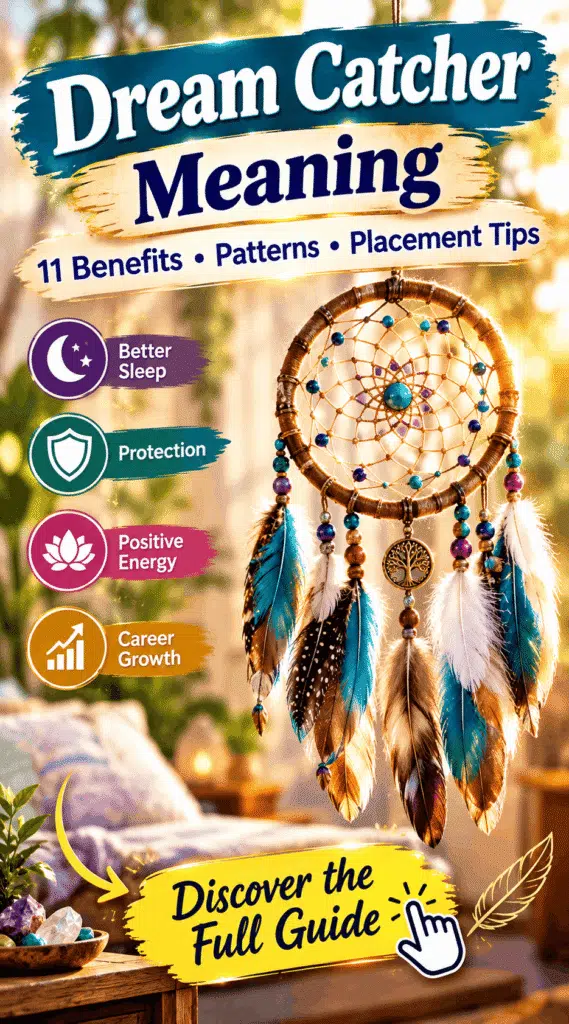
Dream Catcher Colors and Their Meanings
Different colors can influence the appearance and emotional feel of a dreamcatcher.
Many modern guides assign symbolic meanings to dreamcatcher colors, but there is no single traditional color chart recognized across all Indigenous communities.
The following are popular modern color associations, not fixed cultural rules.
| Dream Catcher Color | Popular Modern Meaning | Decorating Idea |
|---|---|---|
| White | Peace, simplicity | Minimalist bedroom |
| Black | Mystery, strength | Contemporary interiors |
| Red | Energy, passion | Warm accent wall |
| Pink | Love, kindness | Soft bedroom décor |
| Orange | Creativity, enthusiasm | Craft or reading area |
| Yellow | Optimism, warmth | Bright bedroom |
| Green | Nature, renewal | Plant-filled room |
| Blue | Calm, tranquility | Relaxing bedroom |
| Purple | Reflection, imagination | Meditation corner |
Decorating tip: Choose colors based on your room’s overall palette and the atmosphere you want to create, rather than assuming a particular color will produce a guaranteed spiritual effect.
If you enjoy combining decorative colors with crystals, explore our guide to crystals for emotional healing for additional symbolic interpretations.
Where to Place a Dream Catcher in Your Home
Where to place a dream catcher is one of the most common questions about these objects.
The bedroom is a natural choice because dreamcatchers are traditionally associated with sleep.
Modern decorative dreamcatchers can also be displayed in other spaces.
Dream Catcher Placement Guide
| Location | Why People Choose It | Important Consideration |
|---|---|---|
| Bedroom wall | Connection with dreams | Hang securely |
| Near a bedroom window | Traditional sunlight symbolism | Avoid harsh light on delicate materials |
| Children’s bedroom | Traditional protective association | Keep completely out of reach |
| Living room | Decorative focal point | Match the décor |
| Home office | Personal inspiration | Avoid clutter |
| Meditation area | Reflection and calm | Choose a quiet location |
| Covered balcony | Decorative interest | Protect from weather |
| Entrance wall | Welcoming decoration | Keep clear of doors and walkways |
1. Where to Hang a Dreamcatcher in the Bedroom
A bedroom wall is one of the most practical places to display a dreamcatcher.
Choose a secure hook or fixture that can support its weight.
If you want it near your bed, position it where it cannot fall onto the sleeping area.
The surrounding wall arrangement matters too. Our Feng Shui mirror above bed guide discusses another common bedroom-placement question.
2. Dream Catcher Placement Near a Window
Some people prefer hanging a dreamcatcher near a window because of the traditional symbolism involving morning sunlight.
However, prolonged direct sunlight can fade feathers, fabrics, and colored threads.
A position with indirect light may be better for preserving the object.
3. Dream Catcher Placement in a Children’s Room
Dreamcatchers have historical associations with protecting children.
However, modern hanging decorations with strings, beads, and feathers can create entanglement, choking, or falling-object hazards.
Never hang a dreamcatcher within reach of a baby or above a crib where it could fall or be grabbed.
Instead, display it securely on a wall far beyond a child’s reach.
Explore our Feng Shui kids’ room guide for additional decorating ideas.
4. Dream Catcher in the Living Room
A dreamcatcher can serve as a decorative accent in a living room.
Consider placing it on a feature wall, near a reading corner, or above a suitable console.
Avoid hanging it where it blocks light or interferes with movement.
5. Dream Catcher in the Office
A small dreamcatcher can add personality to a home office.
Choose a position where it will not distract you or obstruct your screen.
If you enjoy meaningful objects, it may serve as a reminder of calmness and creativity.
6. Dream Catcher in a Meditation Area
A dreamcatcher can complement a quiet reflection space.
Use it alongside comfortable seating, soft lighting, and uncluttered surroundings.
Its use here is personal rather than a requirement of traditional dreamcatcher practice.
For related ideas, see our Feng Shui spiritual growth guide.
7. Dream Catcher Near the Entrance
Some people display dreamcatchers near an entrance as a decorative symbol of welcome and protection.
This is a modern decorative choice, not a universal traditional placement rule.
For broader home arrangement principles, see our guide to Feng Shui your house.
Where to Place Dream Catcher According to Feng Shui
A Feng Shui dream catcher is a modern combination of two distinct cultural ideas.
Dreamcatchers originate in Indigenous North American traditions, while Feng Shui developed in China.
Therefore, classical Feng Shui does not prescribe one official dream catcher direction.
You may encounter advice recommending the southwest, north, or a bedroom window, but these are not universally established rules for dreamcatchers.
Is Southwest the Best Dream Catcher Direction?
The southwest is associated with relationships in some Feng Shui Bagua systems.
However, there is no established classical rule stating that every dreamcatcher must be placed in the southwest.
Choose a location based on the room’s layout, the object’s meaning, and safety.
Can You Use a Dreamcatcher With Feng Shui Elements?
Yes, you can combine a dreamcatcher with a nature-inspired decorating scheme.
For example, a wooden hoop and natural fibers can complement a room that uses wood textures and plants.
This is a contemporary design approach, not a claim that the dreamcatcher is a traditional Chinese cure.
Learn about Feng Shui’s five elements, Feng Shui mirrors, and Feng Shui crystal ball placement to understand other symbolic home-decorating practices.
How to Hang a Dream Catcher Properly
A secure installation is more important than following an unverified compass direction.
Step 1: Choose a Suitable Location
Select a bedroom wall, window-adjacent area, or another appropriate display space.
Avoid damp locations and areas exposed to strong winds.
Step 2: Use a Secure Hook
Choose a fixture suitable for the wall and the weight of the dreamcatcher.
Make sure it cannot easily fall.
Step 3: Check the Hanging Length
Keep long strings, feathers, and decorative beads away from children’s beds and cribs.
Step 4: Avoid Crowding the Space
A single well-positioned dreamcatcher often looks better than several decorations placed too close together.
Step 5: Maintain It Regularly
Remove dust gently and check for loose parts.
How to Cleanse or Activate a Dream Catcher
Many people ask how to activate a dreamcatcher or remove negative energy from it.
There is no universal activation ceremony that applies to every Indigenous tradition.
Some modern spiritual practices involve setting intentions, prayer, sunlight, or smoke cleansing.
These practices should not be presented as requirements of traditional Ojibwe dreamcatcher use.
A Simple Personal Intention Practice
If you enjoy symbolic rituals, you can hang your dreamcatcher carefully and take a quiet moment to reflect on what it represents to you.
For example, you might associate it with peaceful sleep, family care, or gratitude.
No special ritual is required for it to be a meaningful decoration.
How to Clean a Dreamcatcher Safely
Use a soft brush or gentle dusting method.
Avoid soaking delicate feathers, leather, beads, or wooden hoops in saltwater.
Water can damage natural materials, loosen adhesives, and distort the woven web.
If the object was made by an Indigenous artist, follow the maker’s care instructions whenever possible.
Different Types of Dream Catchers and Their Meanings
1. Traditional Ojibwe Dreamcatcher
Traditional Ojibwe dreamcatchers are associated with woven hoops and protective teachings.
Their exact construction and symbolism may vary among makers and communities.
The spider-web design is particularly significant.
2. Crescent Moon Dreamcatcher
Crescent moon dreamcatchers are popular contemporary decorations.
They are often associated with nighttime, dreams, and reflection in modern design.
The crescent shape should not automatically be described as a traditional Ojibwe symbol.
3. Triangle Dreamcatcher
Triangle dreamcatchers use a geometric frame rather than a traditional circular hoop.
Their symbolism is usually personal or modern.
4. Evil Eye Dreamcatcher
This style combines dreamcatcher imagery with an evil eye symbol.
It is a modern cross-cultural decorative design.
5. Tree of Life Dreamcatcher
Tree of Life dreamcatchers often symbolize connection, growth, and family in contemporary decorative interpretations.
6. Macramé Dreamcatcher
Macramé dreamcatchers are popular in bohemian interiors.
They commonly feature cotton cord, decorative knots, and neutral colors.
7. Dream-Inspired Siberian Ritual Objects
Some online articles compare dreamcatchers with ritual objects associated with Siberian shamanic traditions.
However, these objects should not automatically be classified as the same tradition.
Their cultural histories and purposes require separate study.
Interesting Facts About Dreamcatchers
Here are several useful facts about dreamcatchers that help explain their history and modern popularity.
- They have Indigenous origins. Dreamcatchers are especially associated with Ojibwe traditions.
- The spider-web pattern is meaningful. It is connected to protective teachings involving Spider Woman.
- Traditional examples used natural materials. Willow hoops and woven fibers are among the materials associated with historical designs.
- Not all dreamcatchers have feathers. Materials and decorative details vary.
- The circular shape is historically important. Many modern designs use other shapes for decorative purposes.
- Meanings vary. Not every Indigenous community or maker uses identical interpretations.
- They became widely commercialized. Mass-produced designs are now sold around the world.
- Dreamcatchers are not classical Feng Shui objects. The two traditions have different cultural origins.
- There is no proven nightmare-prevention effect. Their protective significance belongs to spiritual and cultural belief.
- Authenticity matters. Learning about the maker and the object’s cultural background can help buyers make respectful choices.
Common Dream Catcher Rules: What Is True?
Many websites publish strict rules about dreamcatchers, but not all of them are supported by traditional teachings.
| Common Claim | What You Should Know |
|---|---|
| Dreamcatchers must face southwest | Not an established universal rule |
| They must be gifted, never purchased | No universal prohibition on buying one |
| They stop nightmares | Traditional belief, not proven treatment |
| Every feather has the same meaning | Symbolism varies |
| They must be activated with sage | No universal requirement |
| They must hang above a crib | Unsafe if within reach or able to fall |
| A fallen feather predicts the future | No reliable basis for this claim |
| Dreamcatchers are Chinese Feng Shui cures | Incorrect cultural origin |
Do Dream Catchers Really Work?
The answer depends on what you mean by work.
In traditional spiritual contexts, dreamcatchers carry meaningful beliefs about protection and dreams.
As decorative objects, they can also make a room feel more personal and welcoming.
However, there is no reliable scientific evidence that dreamcatchers physically filter dreams, eliminate negative energy, or prevent nightmares.
If nightmares are frequent or interfere with daily life, evidence-based sleep support is more appropriate.
Dream Catcher Meaning FAQs
What are the main benefits of a dream catcher?
The main traditional benefit is symbolic protection from disturbing dreams. Modern benefits include decoration, personal comfort, creativity, and cultural appreciation.
Where should I place a dream catcher?
A bedroom wall or a secure location near a window is a common choice. Keep it away from hazards and out of children’s reach.
Which direction is best for a dream catcher?
There is no universally established dreamcatcher direction. The southwest recommendation sometimes found in Feng Shui-inspired articles is not a traditional Ojibwe placement rule.
What is the meaning of a triangle dreamcatcher?
Triangle dreamcatchers are generally modern designs. Their meanings depend on the maker and may include broader geometric symbolism.
What does an evil eye dream catcher mean?
It combines a dreamcatcher with an evil eye symbol, commonly interpreted in modern décor as representing protection. The two symbols come from different traditions.
What do dream catcher patterns mean?
The circular hoop and woven web are associated with traditional dreamcatcher symbolism. Beads, feathers, and modern patterns may have meanings that vary by maker.
What does a dream catcher tattoo represent?
A dreamcatcher tattoo may symbolize protection, personal identity, dreams, or connection with cultural traditions. Its meaning depends on the individual.
What do feathers on a dreamcatcher symbolize?
Feathers have various meanings in popular interpretations, including gentleness and protection. There is no single meaning that applies to every Indigenous tradition.
Can I give a dreamcatcher as a gift?
Yes. A dreamcatcher can be a thoughtful gift, particularly when purchased from an authentic Indigenous maker. There is no universal rule that people cannot buy one for themselves.
For more symbolic gifting ideas, explore our Feng Shui gifts for wealth.
What does it mean when a feather falls off a dreamcatcher?
Usually, it means the feather or its attachment has become loose. There is no reliable basis for treating it as a prediction about dreams.
Can I hang a dreamcatcher above my bed?
You can hang one near your bed if it is securely mounted and cannot fall. Avoid hanging it directly above a sleeping person’s head when a safer wall position is available.
Can dreamcatchers be placed in the living room?
Yes. Modern decorative dreamcatchers can be displayed in living rooms, offices, and other suitable spaces.
Do dreamcatchers need sunlight?
No. Some traditional interpretations associate morning sunlight with the disappearance of unwanted dreams, but direct sunlight is not required for a decorative dreamcatcher and may damage delicate materials.
How do you clean a dreamcatcher?
Dust it gently with a soft brush. Avoid soaking natural materials or using harsh cleaning products.
Are dreamcatchers good luck charms?
Some people use them as symbols of protection or good fortune. Their traditional significance is more specifically associated with dreams and protective teachings.
Related Guides for Positive Home Energy
If you’re interested in meaningful decorations and traditional symbolism, you may also enjoy these articles:
- How to use Feng Shui when preparing to sell a house
- Feng Shui lucky animals and their symbolism
- Feng Shui wind chimes and their meanings
- Chinese New Year flowers and fruits
- How to build a Feng Shui money bowl
- Feng Shui crystals and cures
- Feng Shui practices for spiritual growth
Conclusion: Understanding Dream Catcher Meaning and Benefits
The dream catcher meaning is rooted in Indigenous traditions involving dreams, protection, and care.
Its circular hoop, woven web, and natural materials give it cultural significance, while modern variations offer many decorative possibilities.
Whether you’re exploring dream catcher benefits, patterns meanings, triangle dreamcatcher symbolism, or where to place a dream catcher, the most important thing is to understand the difference between traditional teachings and modern interpretations.
Choose a design that is meaningful to you, display it safely, and respect the cultural history behind it.

Bhawana Rathore is the founder of Feng Shui Tricks and a Feng Shui writer and educator. Feng Shui helped her through a hard time, and since 2020 she has been turning it into clear, practical steps, with more than 400 guides and a set of free calculators for arranging your home, understanding lucky symbols and following the Chinese zodiac. She completed the Professional Diploma Course in Feng Shui (CTAA-accredited course) in 2026 and teaches the same ideas on the Feng Shui Tricks YouTube channel. More about Bhawana. If the guides help you, you can buy her a coffee here.