

The Western vs traditional bagua map question comes down to one thing: what you line the map up with. The Western map lines up with your front door. The traditional map lines up with the compass.
Both use the same nine life areas, so neither is “wrong.” If you’re new to the grid itself, start with our Feng Shui bagua map guide, then come back here to pick your method.
For the compass version you’ll also want to know how to read a Feng Shui compass.

This post contains affiliate links. As an Amazon Associate I earn from qualifying purchases.
The one tool the traditional map needs
As an Amazon Associate we earn from qualifying purchases. Prices and availability come from Amazon.
Western vs traditional bagua map at a glance
| Western (BTB) bagua map | Traditional (compass) bagua map | |
|---|---|---|
| Lines up with | The wall with your front door | True compass directions |
| Tool you need | A floor plan | A floor plan and a compass |
| Shape | A 3×3 grid | An eight-sided map with a center |
| Wealth area | Far-left corner from the door | Southeast |
| Love area | Far-right corner from the door | Southwest |
| Roots | Founded in California in the 1980s | Chinese Compass School tradition |
| Good for | Beginners, apartments, single rooms | Whole houses, deeper classical work |
The two maps only agree when your front door faces north. For any other door direction, a corner can carry one meaning on one map and a different one on the other. That’s the source of most bagua confusion.
What the traditional bagua map is
The traditional map comes from the Compass School. It places the eight trigrams of the bagua on the eight compass directions, with the center of the home in the middle. Each direction has its own element, number and life area.
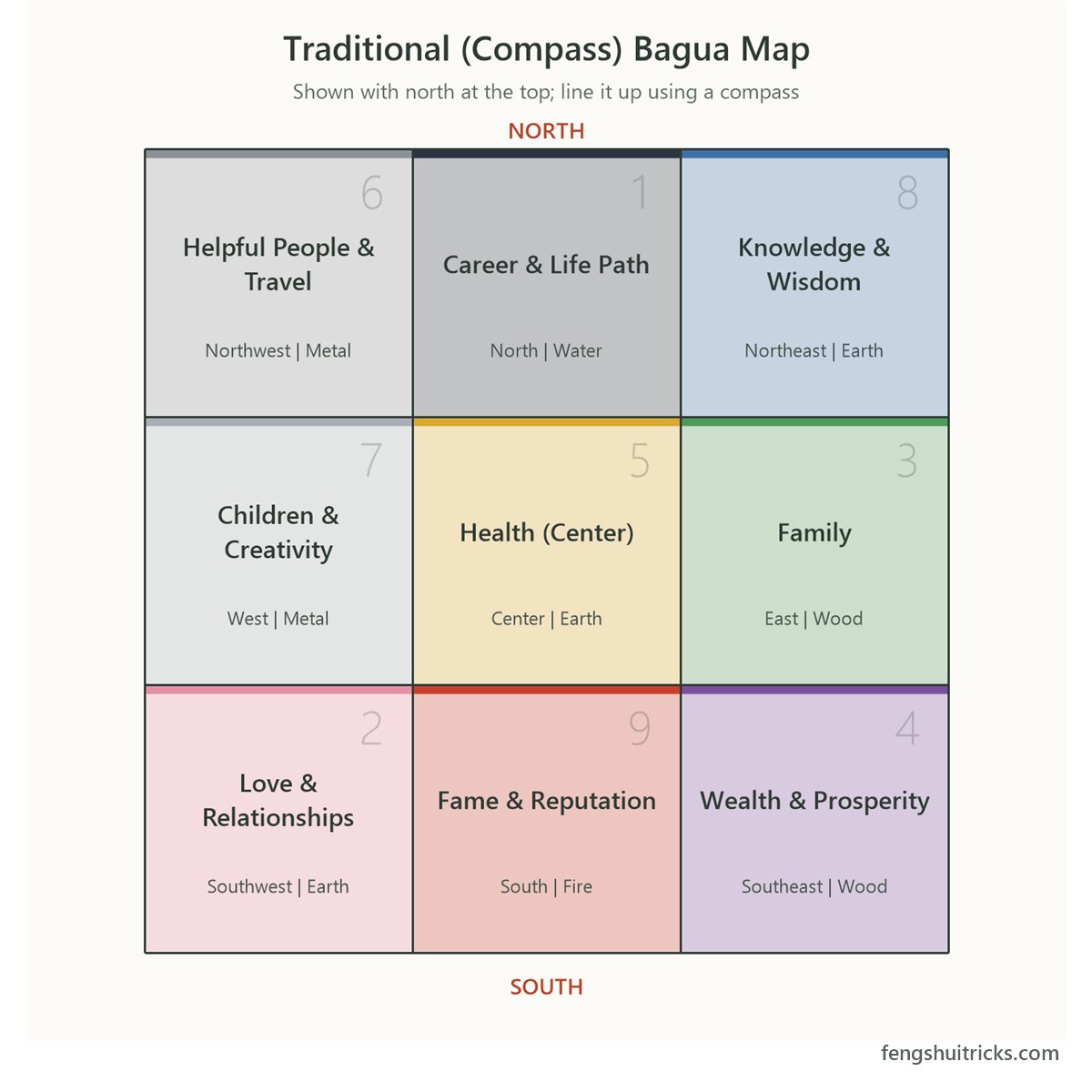
Because the directions never move, the traditional map suits people who also follow Feng Shui directions for beds, desks and doors. It takes a little more work: you need an accurate compass reading.
What the Western (BTB) bagua map is
The Western map ignores the compass. You lay a 3×3 grid over your floor plan so the bottom row sits along the wall with your front door. The door always lands in Knowledge, Career or Helpful People.
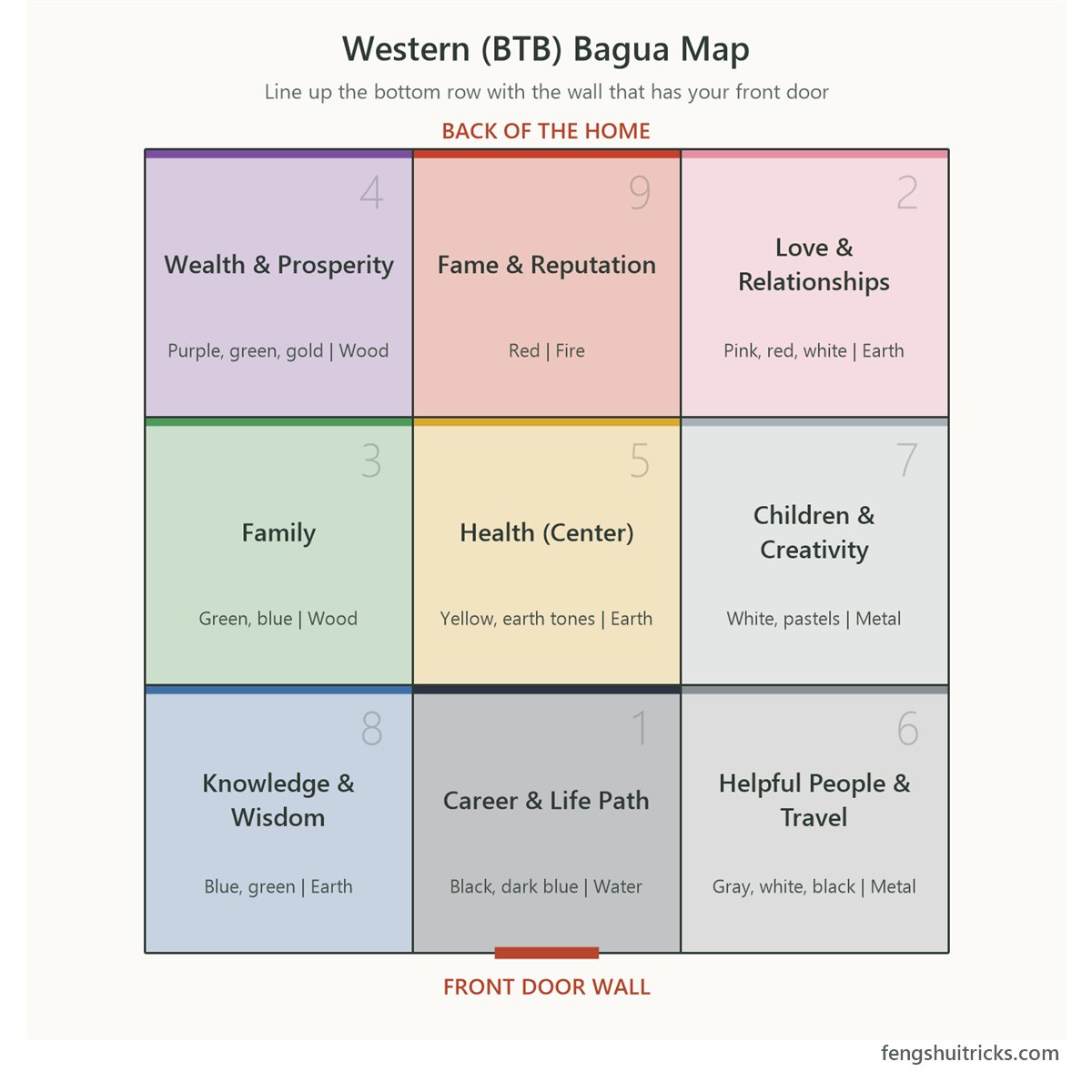
It’s the version most US, UK and Australian Feng Shui books use. According to Britannica, Thomas Lin Yun founded the Black Hat (BTB) style in Berkeley in the 1980s, and it spread widely in the West through the 1990s.
Lin Yun led a Black Sect Tantric Buddhist temple in Berkeley, as a 1996 Cornell notice records. Critics in classical schools call the method simplified; fans like how easy it is to apply.
Side by side: directions, elements and numbers
Each area carries a number from the Lo Shu magic square, where every row adds up to 15. Here’s how the two maps line up:
| Life area | Traditional direction | Western position (from the door) | Element | Number |
|---|---|---|---|---|
| Career | North | Front middle | Water | 1 |
| Knowledge | Northeast | Front left | Earth | 8 |
| Family | East | Middle left | Wood | 3 |
| Wealth | Southeast | Back left | Wood | 4 |
| Fame | South | Back middle | Fire | 9 |
| Love | Southwest | Back right | Earth | 2 |
| Children | West | Middle right | Metal | 7 |
| Helpful People | Northwest | Front right | Metal | 6 |
| Health | Center | Center | Earth | 5 |
For colors and shapes for each element, see our guide to the five Feng Shui elements.
Where your wealth corner lands for your door
Find your door’s facing direction: stand in the doorway looking out and note the compass direction. Then read across to see where the Western areas fall on the compass.
| Front door faces | Western Wealth corner sits in the… | Western Love corner sits in the… | Western Career area sits in the… |
|---|---|---|---|
| North | Southeast (both maps agree) | Southwest (both agree) | North (both agree) |
| South | Northwest | Northeast | South |
| East | Southwest | Northwest | East |
| West | Northeast | Southeast | West |
So with a south-facing door, your Western Wealth corner is the compass’s Helpful People area. Neither is broken; they’re two different maps. Pick one and stick with it.
For ideas once you’ve found the spot, see our Feng Shui wealth boosters.
How to lay each map on your floor plan
Western map in 3 steps
- Sketch your floor plan, with the front door wall at the bottom.
- Divide it into a 3×3 grid of equal parts.
- Label the squares as in the Western diagram above.
Traditional map in 4 steps
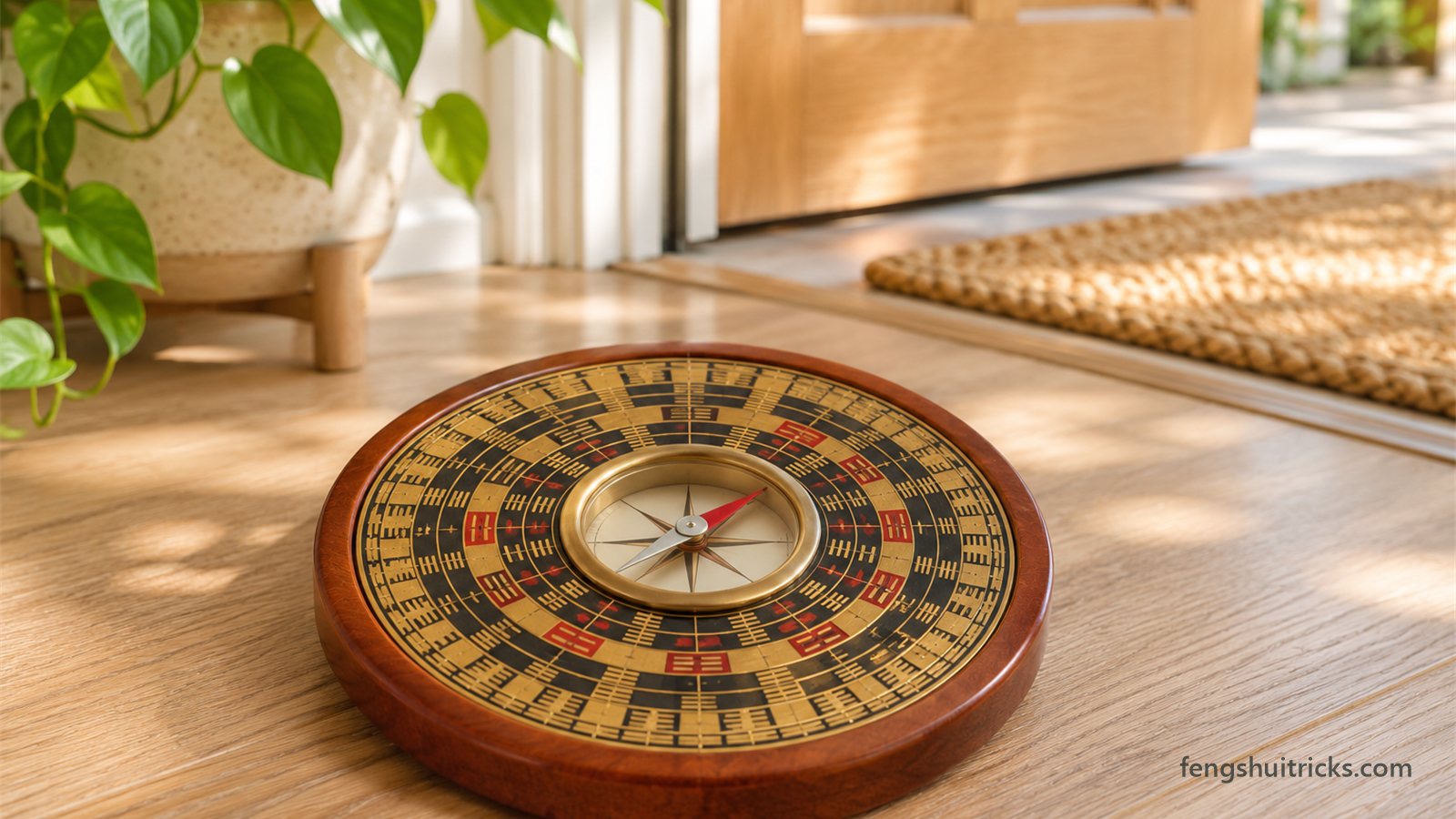
- Find the center of your floor plan.
- Stand in the doorway looking out and take a compass reading. Repeat it in two other spots and average them.
- Draw north, south, east and west through the center, then the four diagonals.
- Label each slice with its life area from the table above.
Which door counts, apartments and two floors
- Which door: use the front door the home was designed around, even if you use the garage. See how to Feng Shui your front door.
- Apartments: map your own unit from its entry door, not the building’s lobby.
- Two floors: map each floor; upstairs, the top of the stairs often stands in for the door.
- Single rooms: the Western grid also works on one room, starting from its doorway.
Which bagua map should you use?
- Choose the Western map if you’re a beginner, rent an apartment, want to work room by room, or follow most English-language Feng Shui books.
- Choose the traditional map if you own a house, already use compass directions or Kua numbers, or want classical Feng Shui.
- Don’t mix them. Using the Western Wealth corner and the compass Love corner at the same time gives you a map that matches neither tradition.
Does the bagua change in the Southern Hemisphere?
This matters for readers in Australia and New Zealand. Most practitioners say don’t flip the traditional map: north stays north, so Fame stays in the south.
A minority swap north and south, because the sun sits in the northern sky there.
There’s no agreement, and no academic source settles it. The Western map avoids the question completely, since it follows your front door, not the sun.
Common mistakes when switching maps
- Reading the compass inside the doorway’s metal frame or next to a fridge.
- Starting the Western grid from a side or garage door.
- Moving all your “wealth” décor every time you read a new article. Choose one map for at least a few months.
- Ignoring the center of your home, which is Health on both maps.
Helpful tools for mapping your home
Tools and cures for each bagua map
 Luo pan compassFind the facing direction of your home.View on Amazon →
 Bagua mirrorHung outside to deflect harsh energy.View on Amazon →
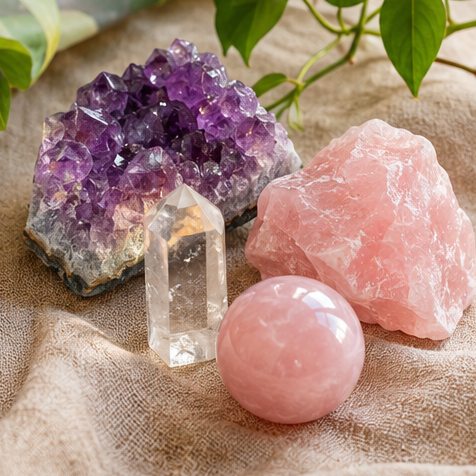 Crystal setAmethyst, rose quartz and clear quartz.View on Amazon →
As an Amazon Associate we earn from qualifying purchases. Prices and availability come from Amazon.
A bagua mirror is an outdoor cure, hung above the outside of a door. It is never placed inside the home.
Frequently asked questions
What is the difference between the Western and traditional bagua map?
The Western (BTB) bagua map is a 3×3 grid lined up with the wall that has your front door. The traditional map is lined up with compass directions, so Wealth is always southeast. Both use the same nine life areas.
Which bagua map is more accurate, compass or front door?
Neither is more accurate; they come from different traditions. Classical practitioners prefer the compass map, while most Western books use the front-door map. What matters most is choosing one and using it consistently.
Where is my wealth corner with each bagua map?
On the Western map, it’s the far-left corner as you stand in the front door looking in. On the traditional map, it’s the southeast part of your home. The two only land in the same place when your front door faces north.
Can I use both bagua maps at the same time?
It’s best not to. Mixing them, such as using the Western Wealth corner with the compass Love corner, gives you a map that follows neither tradition. Pick one and give it a few months.
Which door do I use if I always come in through the garage?
Use the main front door the home was designed around, even if you rarely use it. For an apartment, use your own unit’s entry door rather than the building entrance.
How do I find my home’s facing direction?
Stand in your front doorway looking out and hold a compass flat, away from metal door frames and appliances. Take two or three readings and average them. The direction you’re looking toward is the facing direction.
Does the bagua map change in the Southern Hemisphere?
Most practitioners say no: north stays north, even in Australia. A minority swap north and south. The Western map isn’t affected, because it follows your front door rather than the compass.
Conclusion
The Western and traditional bagua maps share the same nine areas but start from different places. One follows your front door; the other follows the compass.
- Western: line the grid up with the front door wall.
- Traditional: line the map up with a compass reading.
- They only match when the front door faces north.
- Pick one map and use it consistently.
If you only do one thing: choose one map today and find your wealth corner with it, then leave it in place long enough to notice a change.
Recommended reading
- Feng Shui for love
- Feng Shui for career
- Feng Shui for knowledge
- Feng Shui for fame and reputation
- Feng Shui for health
