

A good Feng Shui bedroom layout starts with the bed. Put it where you can see the door from your pillow without lying directly in line with it, with a solid headboard against a solid wall.
Get that right and most other pieces fall into place around it.
This guide covers where the bed goes and why, the placements to avoid, how to solve six awkward room shapes, and where the nightstands, dresser, desk and mirror should sit.



There’s a checklist at the end you can use on your own room tonight.


The quick rules
- Bed in the command position: door in view, but not straight across from your feet.
- Solid support behind you: a real headboard against a wall, not a window.
- Room on both sides: about 24 to 36 inches (60 to 90 cm) where space allows.
- Nothing heavy overhead: no shelves, beams or big frames above the bed.
- No reflections from the pillow: mirrors and screens out of view.
- A clear path: from the bed to the door and to the bathroom.
Where to put the bed: the command position
In Feng Shui, the command position is the spot where you can see whoever comes through the door while your back is protected.
In most bedrooms that means the wall diagonally across from the door, with the bed set so you can see the doorway without twisting your head.
The tradition says this lets you rest without part of you staying on guard. There’s a Western idea that lands in a similar place.
In 1975 the geographer Jay Appleton proposed prospect-refuge theory, the idea that we’re drawn to places that offer both an outlook and a sense of shelter.
A bed with a wall behind it and a view of the door gives you both.

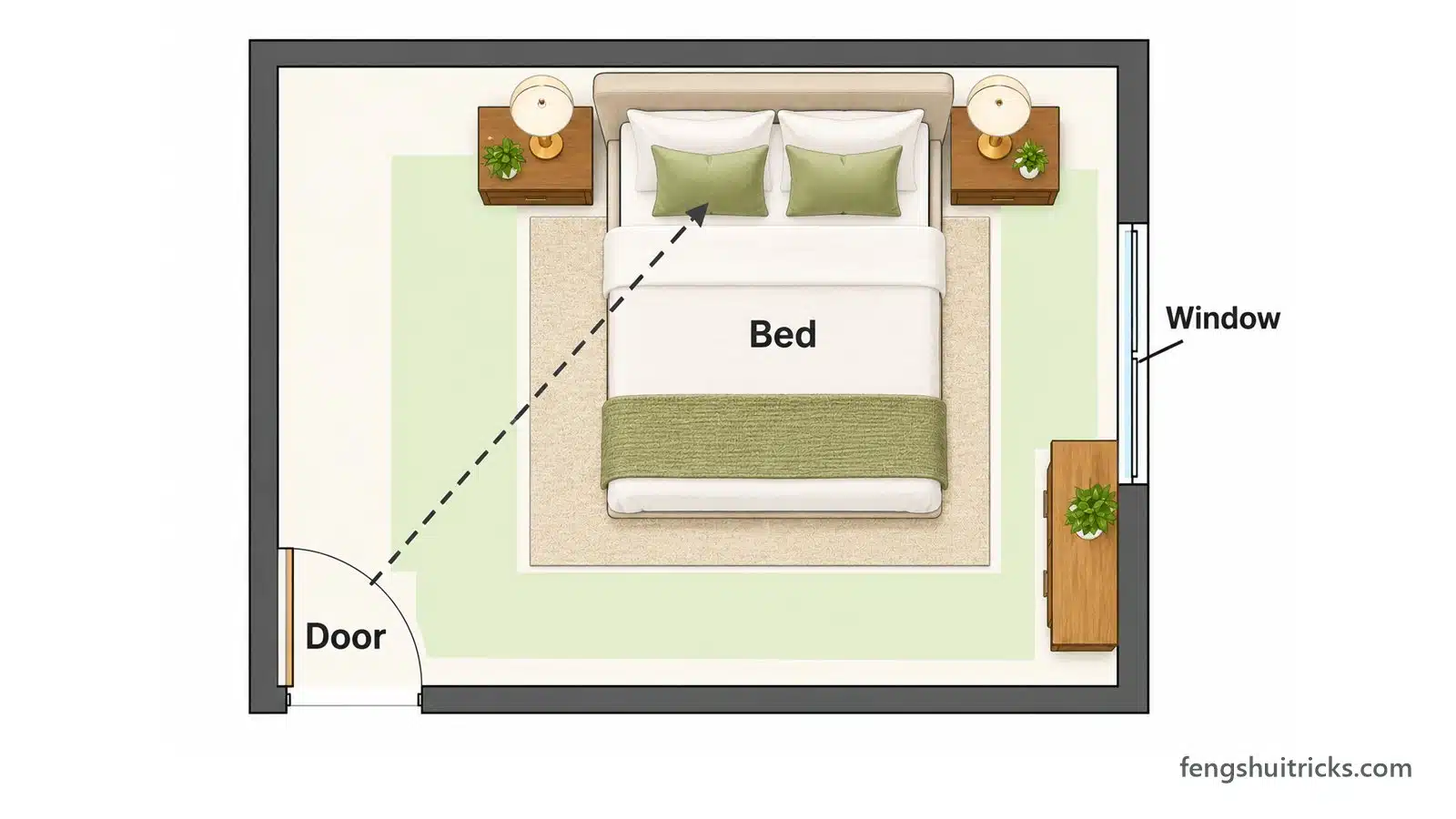
To find the spot in your room:
- Stand in the doorway and look for the solid wall farthest from you that isn’t the door’s own wall.
- Picture the headboard there, off to the side of the doorway’s line rather than dead center opposite it.
- Lie down (or sit on the floor where the pillow would be). You should see the door with a small turn of the head.
- Check the walkways. Most designers allow 24 to 36 inches (60 to 90 cm) on each side so both sleepers can get in and out easily.
If you want the compass side of this, such as which direction your head should point based on your birth year and gender, our bed placement guide goes into it.
Bed placements to avoid (and the fix for each)
| Placement | Why Feng Shui avoids it | Fix if you can’t move the bed |
|---|---|---|
| Feet pointing straight out the door | Folk tradition calls it the “coffin position,” and you’re in the path of everyone coming in | Shift the bed sideways; add a footboard or a bench at the foot |
| Headboard under a window | No solid support behind you; drafts, light and noise | Tall, solid headboard and heavy curtains closed at night |
| Under a beam, sloped ceiling or shelf | Weight pressing down over the sleeper | Move the bed; otherwise soften the beam with fabric and clear any shelf |
| On the same wall as the door | You can’t see who’s coming in | A mirror placed so you can see the door, or a move to another wall |
| Headboard on a wall shared with a toilet or stove | Noise, plumbing and “draining” energy behind your head | Solid headboard with a gap from the wall; keep the bathroom door closed |
| Pushed into a corner | One sleeper is boxed in; energy can’t move around the bed | Pull it out far enough to walk around, or keep the corner bed for a single sleeper |


Two of these have their own guides: what to do about a bed under a window, and how to handle a bedroom under the stairs. The overhead rule has a safety side too.
The CDC’s earthquake checklist advises people to move heavy mirrors and pictures hanging above beds, which is worth doing anywhere.
If your room won’t cooperate: six layouts solved
Plenty of bedrooms don’t have a perfect wall diagonal from the door. Here’s what to do in the most common cases.
1. The door is on the only long wall
Put the headboard on the wall facing the door but slide the bed toward the far corner, so your feet aren’t lined up with the doorway. A chest or bench at the foot of the bed adds a visual buffer.
2. The only free wall has a window
Use a tall, solid headboard and leave a few inches between it and the glass. Lined or blackout curtains, closed at night, give you the “wall” Feng Shui wants and keep out streetlight.
3. The en-suite door faces the bed
Keep the bathroom door closed, especially at night, and make sure the bed isn’t directly in line with it if you can shift it a little.
The Sleep Foundation also suggests keeping a clear path from the bed to the bathroom, so don’t block it with furniture.
4. A small or box room
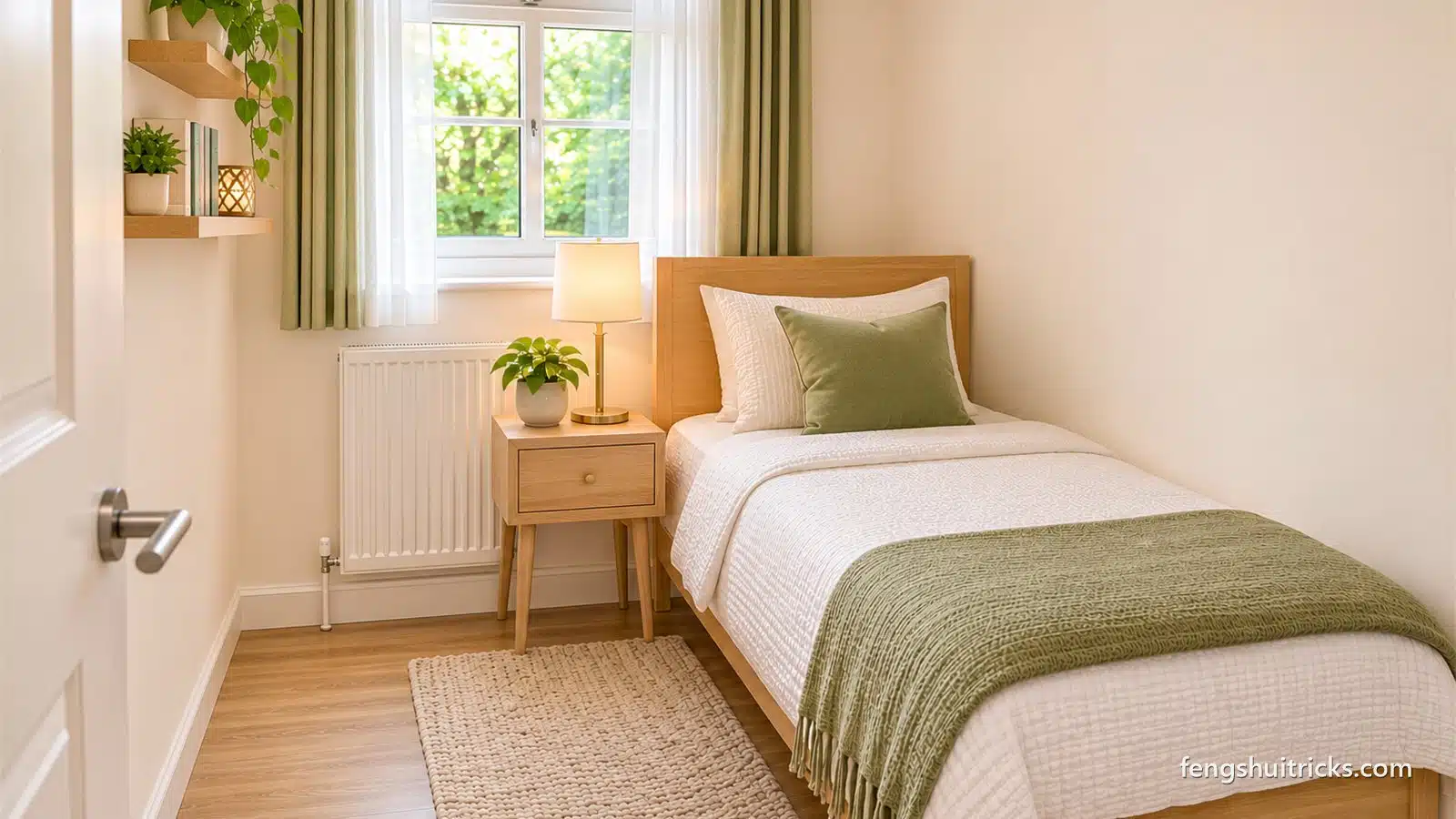
In a UK box room or a small US spare room, a single or full bed may only fit against a side wall. That’s fine for one sleeper.
Keep the open side facing the door, use a slim nightstand, and go vertical with storage. Our small bedroom guide has more space-saving ideas.

5. A bedroom that’s also an office
Keep the desk out of sight from the pillow if you can, or close it off at night with a folding screen or a cabinet door.
Place the desk so you face the room rather than a wall, using the same command idea as the bed. The office desk guide covers the details.
6. A rental you can’t change much
Work with what moves. A headboard that attaches to the bed frame, a rug that anchors the bed, and curtains on a tension rod can fix most problems without drilling.
Don’t push the bed tight against a radiator, which is common under UK windows. Leave a gap for safety and comfort.
Headboard and nightstands
This post contains affiliate links. As an Amazon Associate I earn from qualifying purchases.
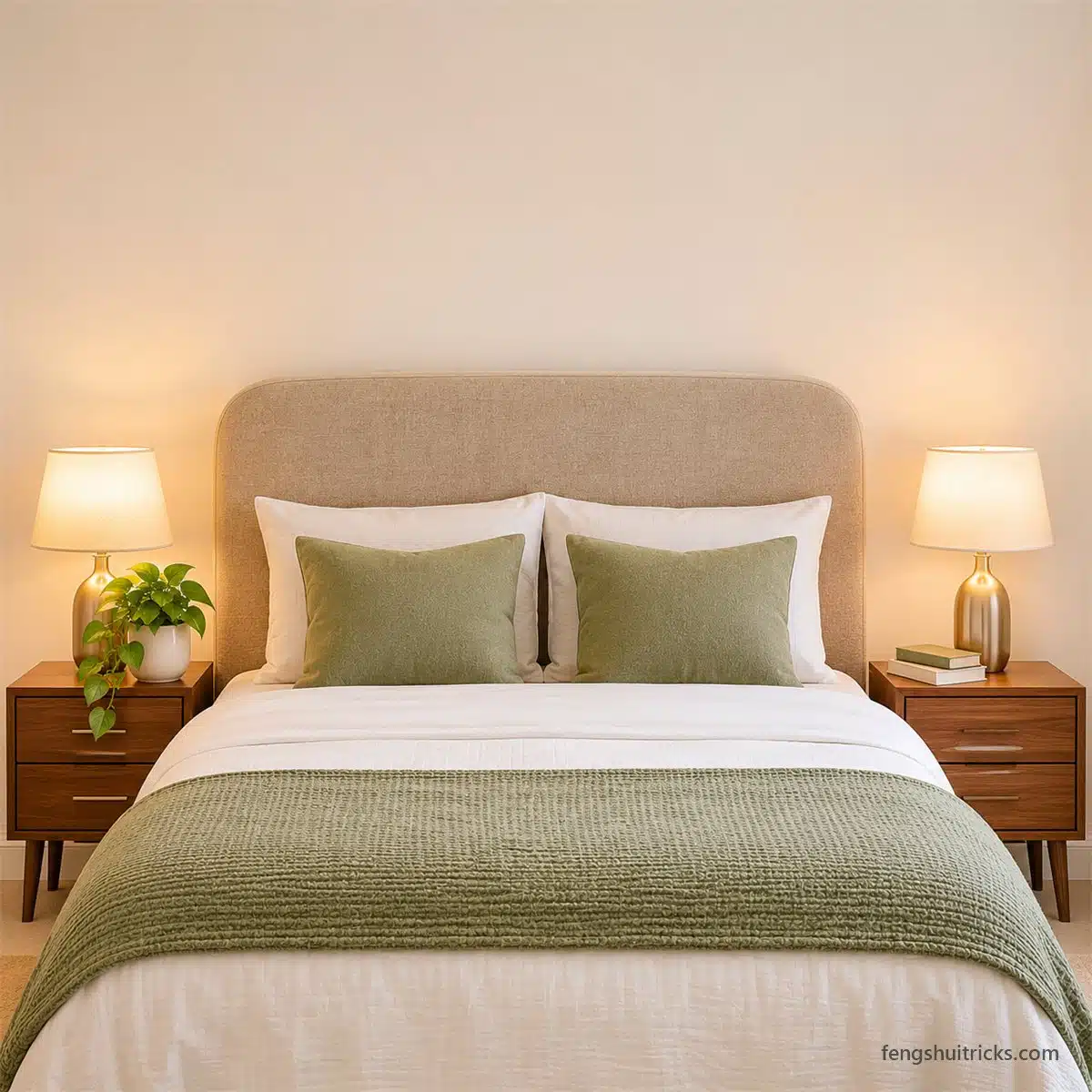
A solid headboard gives the support a wall alone can’t. Wood or an upholstered headboard both work; slatted or metal ones with big gaps feel less steady. Rounded or rectangular shapes are usually preferred over sharp points.
Nightstands on both sides keep the bed balanced, and for a couple, matching ones send the message that both people have equal space. They don’t have to be identical, just similar in size.
A lamp on each side is better than a single overhead light at night. See our nightstand rules for what to keep on them.

Pieces for your nightstands
 Himalayan salt lampSoft, warm light for calm rooms.View on Amazon →
 Mandarin duck pairA classic symbol of love and marriage.View on Amazon →
 Crystal setAmethyst, rose quartz and clear quartz.View on Amazon →
As an Amazon Associate we earn from qualifying purchases. Prices and availability come from Amazon.
Dresser, mirror, desk and TV
- Dresser: against a side wall or the wall facing the bed, with clear floor in front of the drawers.
- Mirror: anywhere you can’t see it from the pillow, such as inside a closet door. Here’s why a mirror above or facing the bed is avoided and how to fix it.
- Desk: as far from the bed as the room allows, facing into the room.
- TV and devices: ideally out of the bedroom. If the TV stays, cover it or keep it in a cabinet at night, and charge your phone out of arm’s reach.
Clutter, under-bed storage and light
Feng Shui treats clutter as stuck energy, and sleep researchers point out that visual clutter can be a source of stress. Keep the floor clear around the bed and the top of the dresser tidy.
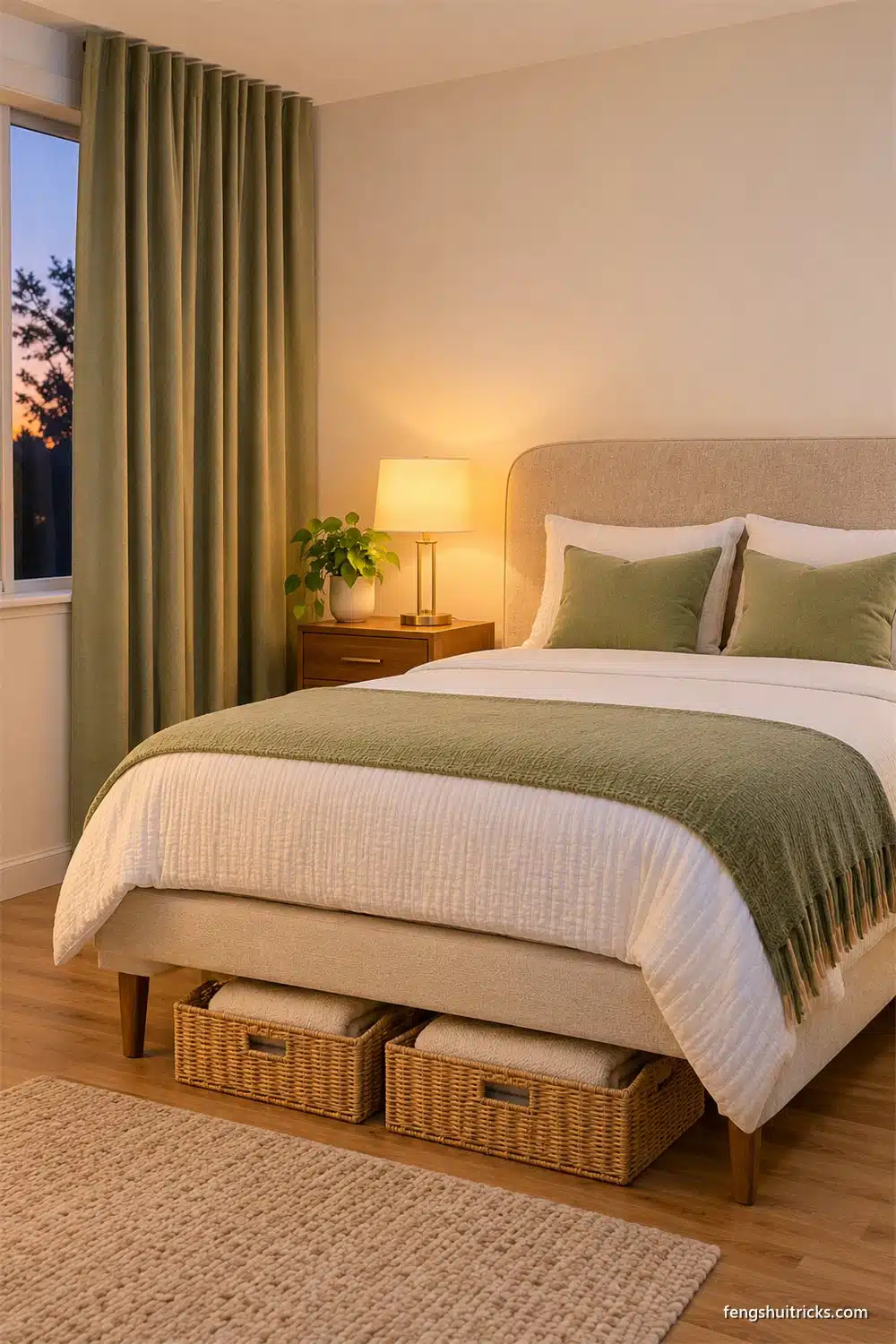
If you need under-bed storage, keep it to soft, sleep-related things like spare bedding rather than paperwork or exercise gear.
For light, think layers: daylight by day, warm lamps in the evening and real darkness at night. If streetlight gets in, blackout curtains are the simplest fix.
Calm, soft colors help too, and our bedroom colors guide explains which shades suit which goals.
Schools differ: does compass direction matter?
Ask three Feng Shui practitioners which way your bed should face and you may get three answers.
- Form School focuses on what you can see: the door, the wall behind you, beams, windows. Everything in this guide comes from it.
- Compass School adds directions, often using a personal Kua number worked out from your birth year and gender to find your best sleeping direction.
- Western, or BTB, Feng Shui measures everything from the door rather than the compass, and uses the bagua map laid over the room.
What this means for you: get the layout right first, because every school agrees on the basics. If a compass direction fits on top of a good layout, great.
If it would push your bed under a window or in line with the door, most practitioners would keep the layout.
Your Feng Shui bedroom layout checklist

- I can see the door from my pillow without lying in line with it.
- My headboard is solid and against a wall.
- There’s space to walk on both sides of the bed.
- Nothing heavy hangs over the bed.
- No mirror or screen faces me in bed.
- The path to the door and bathroom is clear.
- The room gets properly dark at night.
- Under the bed holds bedding, not boxes of everything else.
Frequently asked questions
Which direction should my bed face in Feng Shui?
Form School cares less about the compass than about the door: face into the room with the door in view, not in line with your feet. Compass-based schools add a personal best direction based on your birth year and gender. When the two clash, keep the good layout.
Can a bed go in a corner?
For one sleeper in a small room, yes, as long as you can still see the door. For couples it’s best avoided, because the person on the wall side has to climb over to get out, which Feng Shui reads as one partner being boxed in.
What should I avoid in a Feng Shui bedroom?
The usual list: a mirror facing the bed, heavy things overhead, the bed in line with the door, work piles and exercise gear in view, and screens close to the pillow. Clutter under the bed is on most lists too.
Is it bad if my bed faces the bathroom door?
It’s one of the less ideal setups, mainly because of noise, light and smells at night. Keep the bathroom door closed, shift the bed a little off the line of the door if you can, and keep the path between them clear.
Conclusion
A good Feng Shui bedroom layout comes down to a few moves: the bed where you can see the door, solid support behind your head, space on both sides and nothing pressing down from above.
Everything else, from nightstands to curtains, builds on that.
If you only change one thing, move the bed until you can see the door from your pillow, then work through the checklist above one item at a time.
Our full bedroom Feng Shui guide picks up where this one ends.
Recommended reading
- Feng Shui for better sleep
- Bedroom Feng Shui for couples
- Choosing bedroom lamps with Feng Shui in mind
- Feng Shui for a teenager’s bedroom
- The best plants for a Feng Shui bedroom

Bhawana Rathore is the founder of Feng Shui Tricks and a Feng Shui writer and educator. Feng Shui helped her through a hard time, and since 2020 she has been turning it into clear, practical steps, with more than 400 guides and a set of free calculators for arranging your home, understanding lucky symbols and following the Chinese zodiac. She completed the Professional Diploma Course in Feng Shui (CTAA-accredited course) in 2026 and teaches the same ideas on the Feng Shui Tricks YouTube channel. More about Bhawana. If the guides help you, you can buy her a coffee here.
Bhawana
Sunday 12th of July 2020
Thank You! Tanya
Bhawana
Sunday 12th of July 2020
Thank You!