

Most Feng Shui teachers advise against a mirror above bed placement, whether it’s on the wall over the headboard or on the ceiling. They’re just as wary of a mirror that shows you lying in bed.
The quickest fix is to move it somewhere you can’t see from your pillow, or onto the inside of a closet door.
Below you’ll find why the rule exists (the traditional reasons and the practical ones), when a mirror near the bed is fine, and simple fixes for renters and small bedrooms.




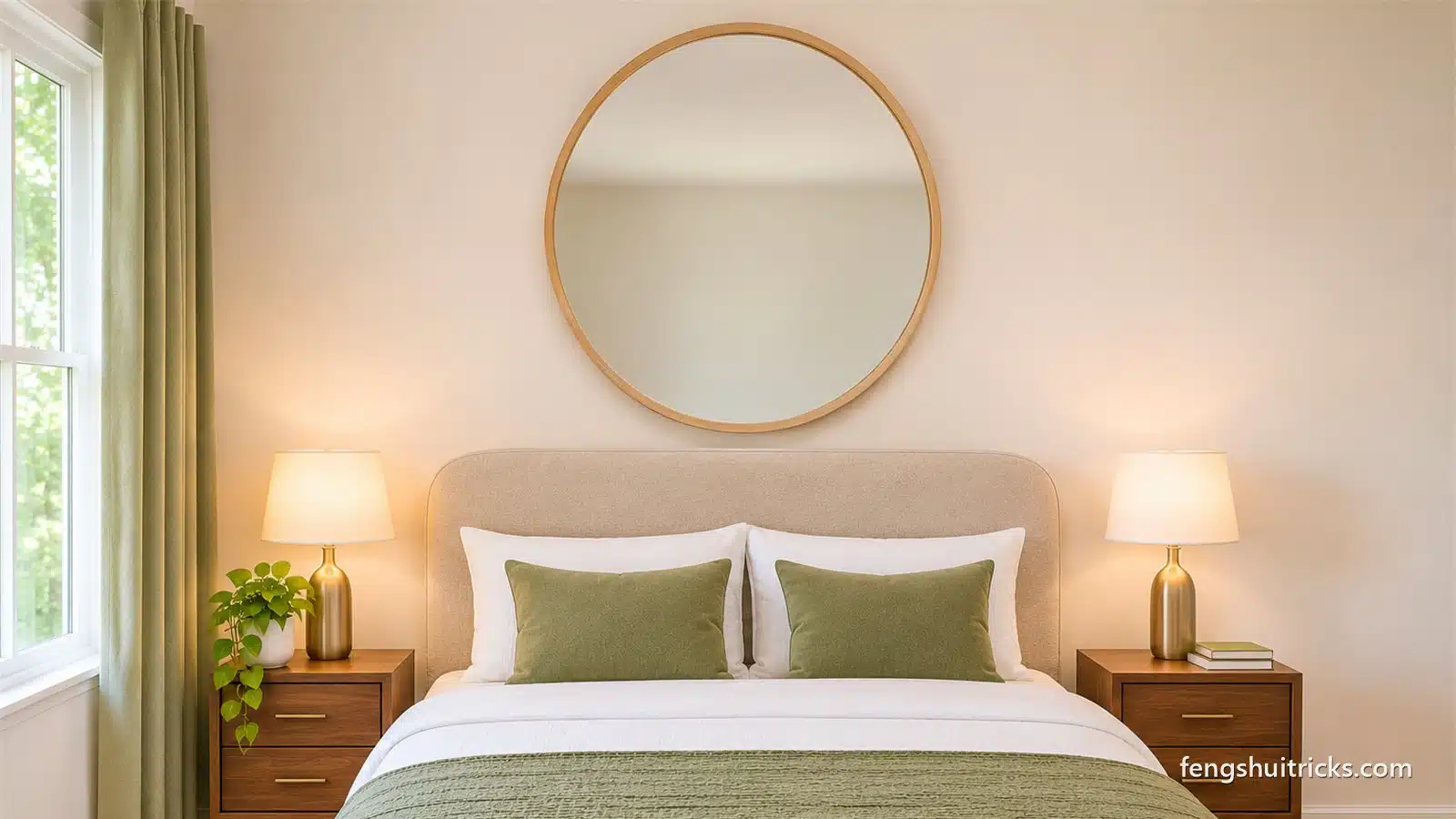
Mirror above bed: the short version
- Above the headboard: best moved. If it stays, keep it light and fixed into wall studs.
- On the ceiling over the bed: the one placement nearly every school rules out.
- Facing the bed: angle it, cover it at night, or move it.
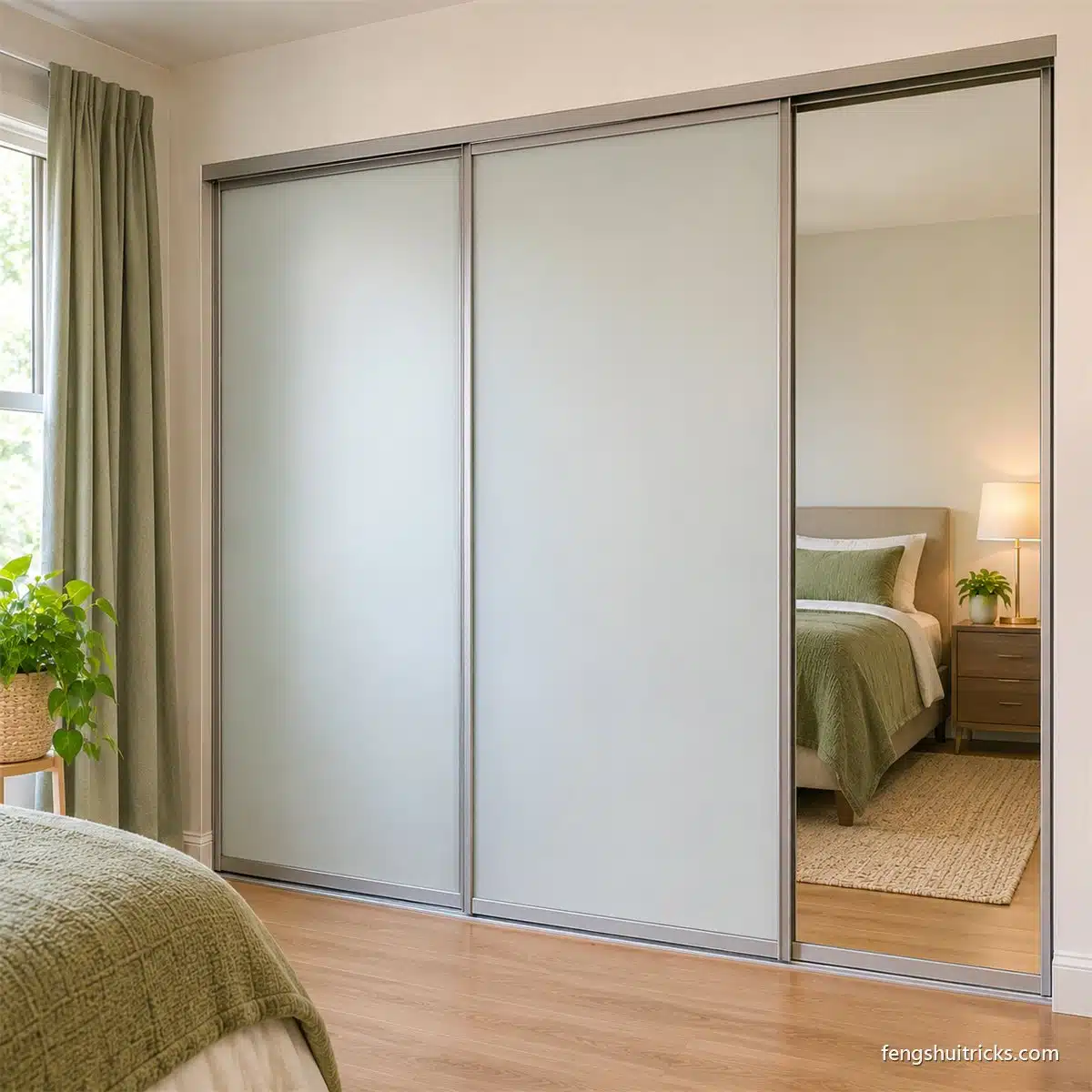
- Mirrored closet doors near the bed: frosted film or a curtain fixes them, no landlord needed.
- A small mirror in a drawer or inside a closet: no problem at all.
Why Feng Shui says no to a mirror over the bed
A bedroom is meant to be the quietest room in the home. In Chinese thought, rest and darkness belong to yin, while light and activity belong to yang. Mirrors are about as yang as decor gets.
They bounce light, catch movement and make a room feel busier. Feng Shui also links them with the water element, which stands for flow and movement rather than stillness.
There are two more reasons, and neither needs any belief in energy at all.
Nobody sleeps well under something heavy
Classical Feng Shui dislikes weight over a sleeping head. That’s why exposed beams, shelves and heavy art above the bed come up in the same breath as mirrors. Safety advice agrees.
The CDC’s earthquake checklist tells people to move heavy mirrors and pictures hanging above beds, or fix them into wall studs with wire and eye screws if they can’t be moved.
That matters most in California, the Pacific Northwest and New Zealand, but a mirror on a single picture hook can come down anywhere.
Mirrors move light around at night
A mirror opposite a window or door picks up streetlight, passing headlights, the hallway light and the glow of a phone on the nightstand, then throws it back toward the bed.
The Sleep Foundation explains that light at night can disrupt your sleep cycles, and it recommends keeping the bedroom as dark as you can.
Better sleep is one of the changes Feng Shui brought to my own home, so this is the rule I’d start with.
Above the bed, facing it or on the ceiling: what’s the difference?
People say “mirror above the bed” for a few different setups, and tradition and common sense rate them a little differently.
| Where the mirror is | What Feng Shui says | The practical issue | Easiest fix |
|---|---|---|---|
| Wall above the headboard | Avoid: activity right behind your head | Weight over a sleeping person | Move it, or swap in light art fixed into studs |
| Ceiling over the bed | The clearest no, in nearly every school | Weight and glare straight above you | Take it down, or frost it |
| Opposite the bed | Avoid: it shows you to yourself all night | Light and movement in your eyeline | Angle it, cover it at night, or move it |
| Mirrored closet doors beside the bed | Avoid if you can see yourself from the pillow | A big shiny surface that catches window light | Frosted film or a curtain |
| Dresser or vanity mirror | Fine if it doesn’t show the bed | Usually none | Tilt it slightly |
| Hand mirror, or one inside a closet | Fine | None | Nothing to do |
Then there’s the superstition. A mirror facing the bed is often said to invite a “third person” into a relationship, or to unsettle the soul while you sleep.
These are folk beliefs layered on top of Feng Shui rather than core teaching, so read them as tradition, not as a forecast for your marriage.

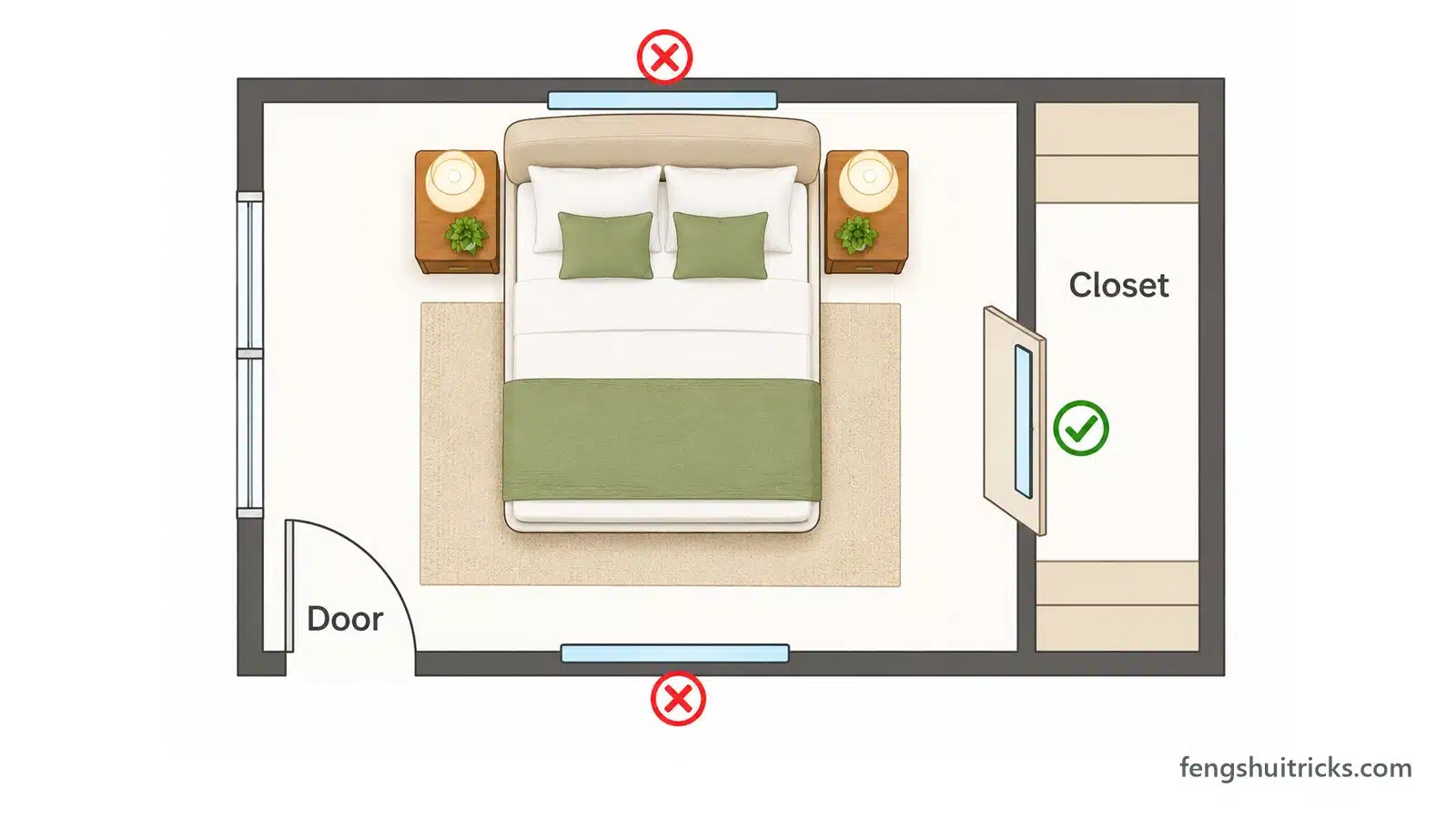
When a mirror near the bed is fine (schools differ)
Not every school treats this the same way. In Western, or BTB, Feng Shui, a mirror is sometimes used on purpose.
If your bed can’t sit in the command position, where you can see the door without being in line with it, a mirror that lets you see the door from bed is a recognized fix.
Classical practitioners are more cautious about any mirror that reflects the bed, and most would move the bed before adding glass.
So what should you do? If you sleep well and the mirror is light and secure, there’s no reason to worry. If your sleep has been patchy, it’s one of the cheapest things to test.
Cover it for a week and notice whether the room feels calmer.
Try the pillow test
Do this at night, with the lights and curtains the way you normally have them.

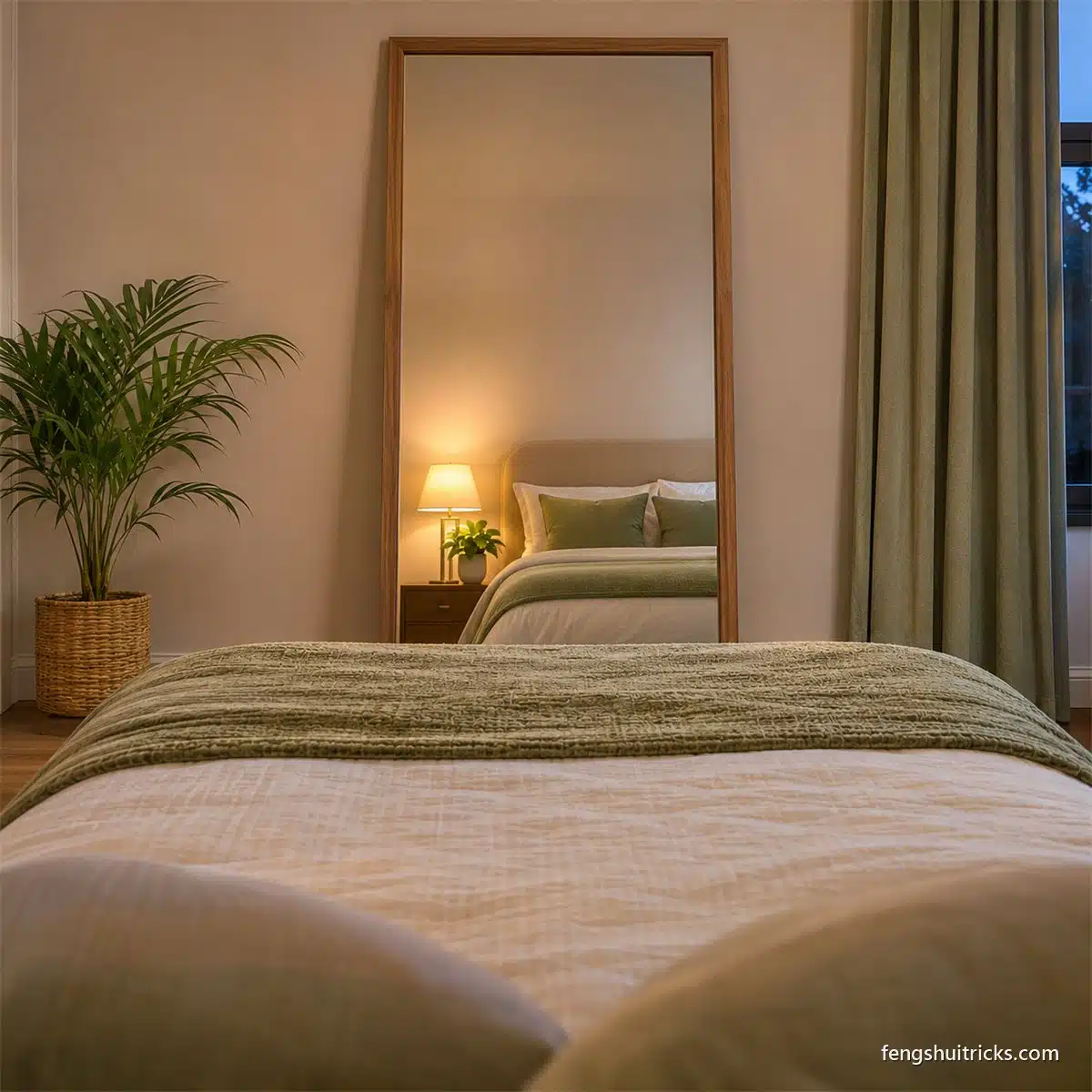
- Lie down in your usual spot. Can you see yourself in any mirror? Then it’s facing the bed.
- Look for flickers: a reflected streetlight, a TV standby light, the hallway light under the door.
- Look straight up. Is anything heavy hanging over your head?
- Turn toward the door. Can you see who’s coming in without twisting? If not, that’s a layout question, and our bedroom layout guide walks through it.
Any “yes” to the first three is worth fixing. Here’s how, from least effort to most.
How to fix a mirror above or facing the bed
This post contains affiliate links. As an Amazon Associate I earn from qualifying purchases.
- Angle it. A freestanding or leaning mirror often needs only a few inches of turn to reflect a wall or window instead of the bed.
- Cover it at night. A light throw, a scarf or a fabric panel works. The habit also has roots in much older customs, which we look at in why some people cover mirrors at night.
- Frost the glass. For mirrored closet doors, a removable frosted window film takes away the reflection and peels off when you move out.
- Move the full-length mirror inside the closet. An over-the-door mirror on the inside of a closet or bedroom door is there when you get dressed and out of sight when you sleep.
- Take it out of the bedroom. A hallway or entry usually suits a big mirror better. Our mirror placement guide covers the spots to skip there, like straight across from the front door.

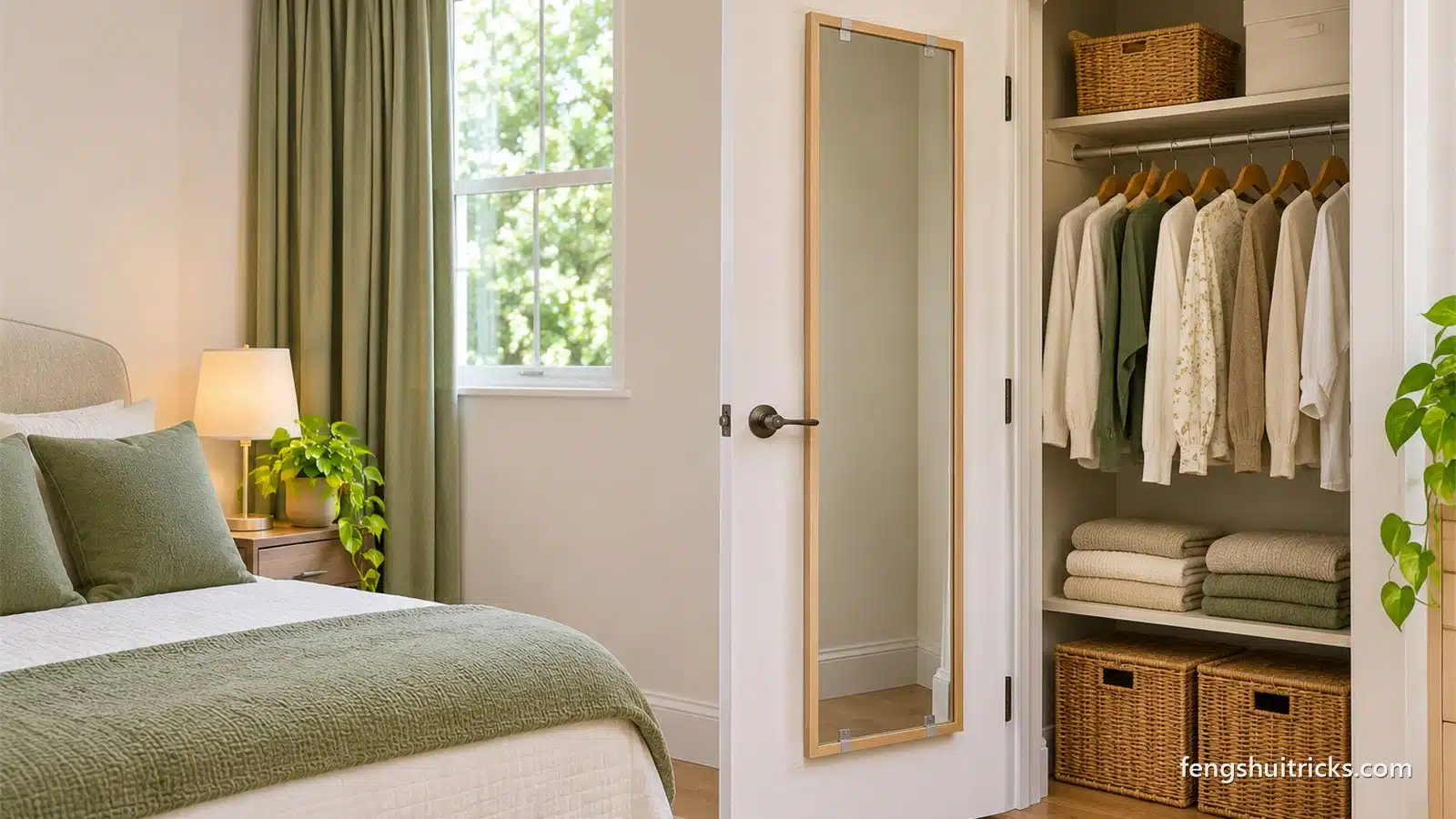
Mirrored closet doors: the most common problem
Sliding mirrored closet doors are everywhere in US apartments and older condos, and plenty of UK bedrooms have fitted wardrobes with mirrored fronts. In a rental you usually can’t take them off, and you may not want to.
You have three renter-friendly options. Frost the panels that face the bed and leave one clear for dressing. Hang a curtain in front of them on a ceiling track or tension rod.
Or leave the doors alone and shift the bed so the mirrors sit beside you rather than at your feet.
In a small bedroom, frosting only the lower half keeps some of the extra light that makes the space feel bigger.

What to hang above the bed instead
The wall over the headboard can look bare, and that’s usually how mirrors end up there. Calmer choices:

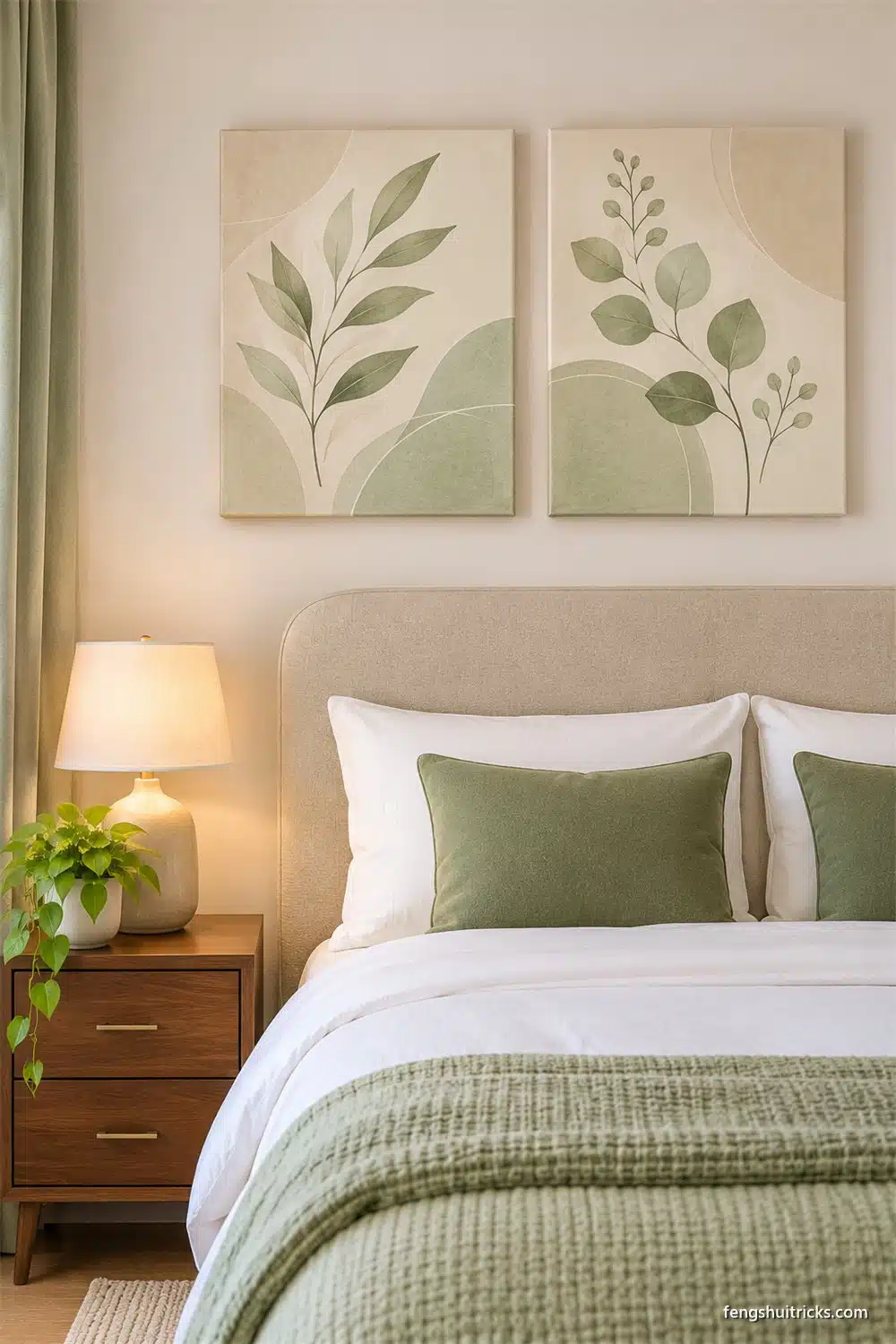
- A light canvas or print without glass, hung on two hooks screwed into studs rather than one nail.
- Something soft: a textile hanging, a quilt, or an upholstered headboard that runs higher up the wall.
- Art in a pair if you share the bed. Pairs stand for partnership in Feng Shui, and a gentle, happy image suits the room better than a busy one. There are more ideas in our bedroom tips for couples.
- Nothing at all. A plain wall behind a solid headboard is a good Feng Shui setup in its own right.
Calm, traditional pieces for the bedroom
 Mandarin duck pairA classic symbol of love and marriage.View on Amazon →
 Crystal setAmethyst, rose quartz and clear quartz.View on Amazon →
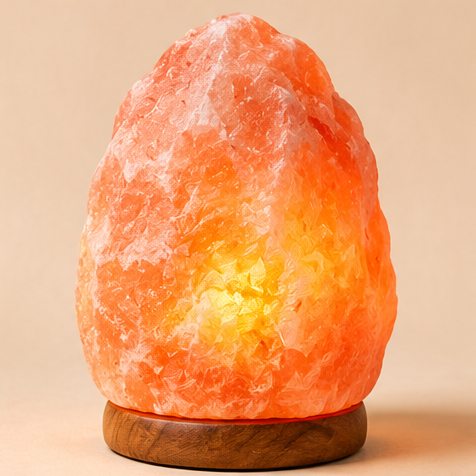 Himalayan salt lampSoft, warm light for calm rooms.View on Amazon →
As an Amazon Associate we earn from qualifying purchases. Prices and availability come from Amazon.
Mandarin ducks are the classic Chinese symbol of a faithful couple. They’re usually set in a pair on a nightstand or dresser rather than hung above the bed.
Where a mirror can go in the bedroom
- Inside a closet door or wardrobe.
- On a side wall you can’t see from the pillow. Check from the bed before you drill.
- In a dressing area or by the door to an en-suite, as long as it doesn’t reflect the bed or the toilet.
- Across from a window, if it brightens a dark room by day. Draw the curtains at night so it doesn’t send light back at you.
For the rest of the room, start with our guide to Feng Shui in the bedroom and these bedroom tips for better sleep.
Frequently asked questions
Why do people say to avoid mirrors at 3 a.m.?
It comes from internet folklore, mostly social media stories about mirrors and spirits in the small hours. It isn’t part of traditional Feng Shui teaching. The Feng Shui concern is simpler: a mirror that reflects you or bounces light while you sleep makes the room less restful at any hour.
Is a mirror on the ceiling above the bed bad Feng Shui?
Yes, and it’s the placement almost every school agrees on. It puts glass directly over you and reflects you all night. If you’ve inherited one in a rental, frosted film or a fabric canopy hides it until you can ask the landlord about taking it down.
Is a small mirror on the nightstand OK?
A compact or hand mirror is fine. Keep it in the drawer, or lay it face down at night so it isn’t catching light from a lamp or phone.
Can a mirror above the bed ever help a couple?
A few practitioners suggest a round mirror as a symbol of unity, but most advise against any mirror over the bed. If you’d like a symbol of partnership, a pair of objects or a piece of art showing two of something does the same job without the downsides.
Does a TV count as a mirror?
Pretty much. When it’s off, a big screen reflects like a dark mirror, and when it’s on it brings light and noise into the room. If it has to stay, cover it at night or keep it in a cabinet with doors.
Conclusion
A mirror above bed, or one facing it, is one of the easiest Feng Shui fixes there is.
Most schools advise moving it, the practical reasons (weight overhead and light at night) point the same way, and a cover, a strip of frosted film or a spot inside the closet door solves it in an afternoon.
If you only do one thing: lie in bed tonight and look at what you can see. If it’s your own reflection, or anything heavy above your head, move it or cover it.
Recommended reading
- Using mirrors as Feng Shui cures
- Decorating with mirrors the Feng Shui way
- Bed under a window: fixes that work
- Feng Shui bedroom colors
- Feng Shui rules for nightstands

Bhawana Rathore is the founder of Feng Shui Tricks and a Feng Shui writer and educator. Feng Shui helped her through a hard time, and since 2020 she has been turning it into clear, practical steps, with more than 400 guides and a set of free calculators for arranging your home, understanding lucky symbols and following the Chinese zodiac. She completed the Professional Diploma Course in Feng Shui (CTAA-accredited course) in 2026 and teaches the same ideas on the Feng Shui Tricks YouTube channel. More about Bhawana. If the guides help you, you can buy her a coffee here.